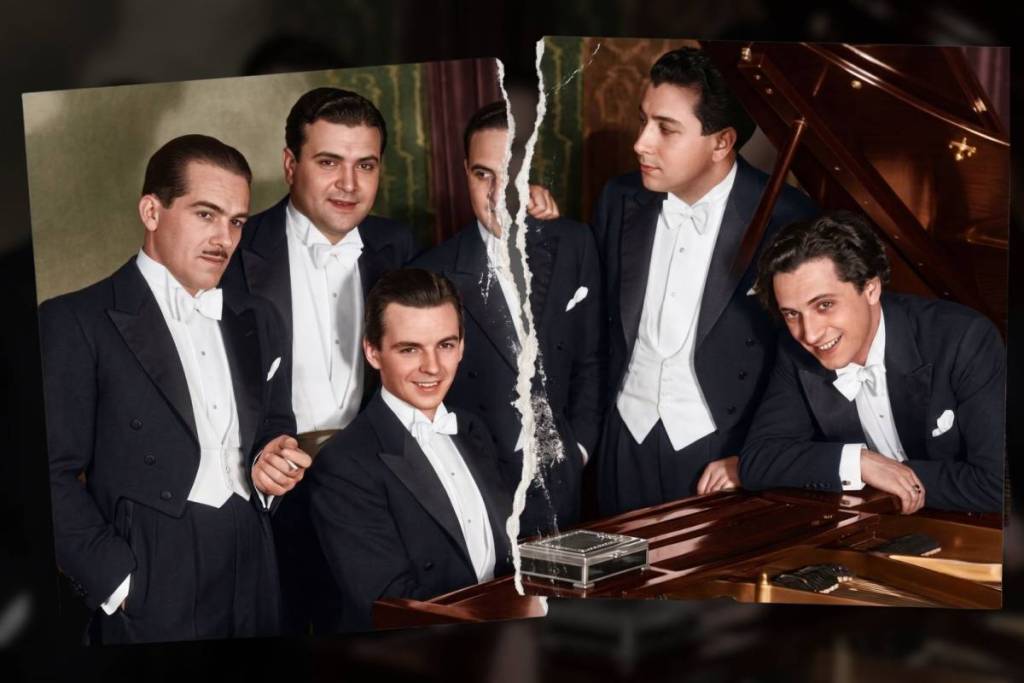

Berlin, 1927. The young acting student Harry Frommermann had heard a record by the American Revelers and was electrified: There had to be something like this in German, too—a vocal ensemble that sounded like an entire orchestra.
He placed a newspaper ad looking for singers—and only the very best. After numerous auditions, the cast was set: Ari Leschnikoff, Roman Cycowski, Erich A. Collin, Robert Biberti, and Erwin Bootz on piano. Rehearsals took place in Frommermann’s apartment in Friedenau.
From the Living Room to the Limelight
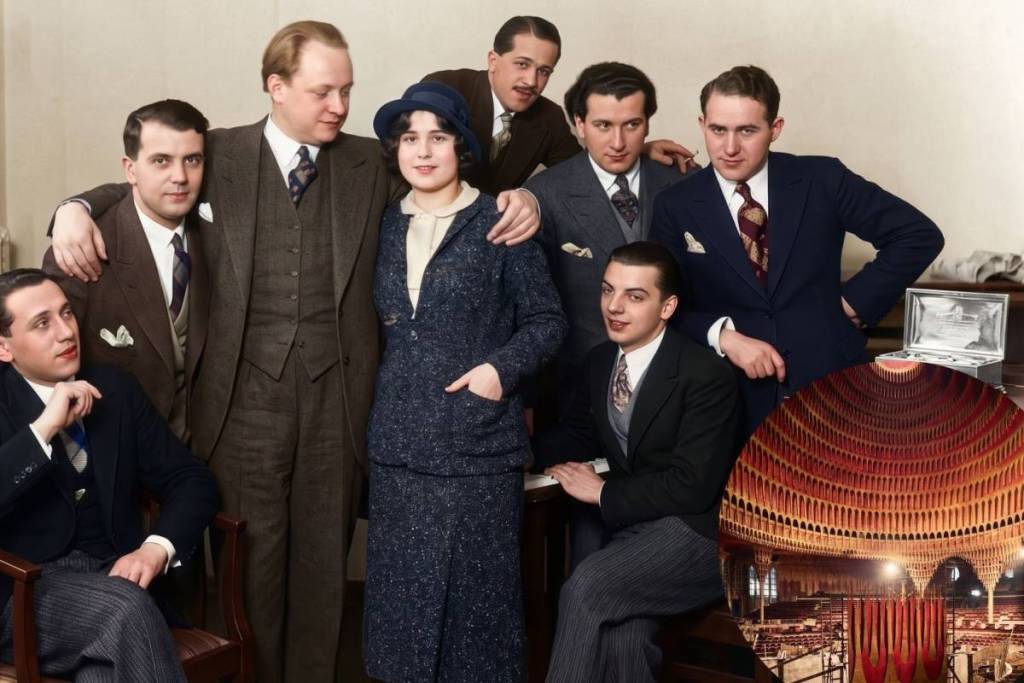
In 1928, they made their breakthrough at the Großes Schauspielhaus (see image detail above), which later became the Friedrichstadt-Palast. From then on, their career took off. The audience loved the mix of singing and humor: five voices imitating a trumpet, trombone, and percussion, accompanied by a piano, tongue-in-cheek lyrics, and perfectly tailored tailcoats.
Hits like “Veronika, der Lenz ist da,” “Wochenend und Sonnenschein,” and “Mein kleiner grüner Kaktus” were played on every radio station. Their records sold by the millions, followed by film appearances and tours throughout Europe and the U.S. Fans, star culture, a carefully crafted image—it’s safe to say: This was Germany’s first boy band.
The Sudden End
But their good fortune lasted only a few years. Three of the six members were Jewish or of Jewish descent: Frommermann, Cycowski, and Collin. After 1933, the situation became increasingly threatening for them; performances were banned, and by 1934, their time in Germany was finally over.
The three non-Jewish members—Biberti, Bootz, and Leschnikoff—remained in Germany and continued with new singers as the “Meistersextett”; from 1935 onward, they even used the officially approved suffix “formerly the Comedian Harmonists.”
For those who were excluded, this is a betrayal: the collective name they all worked to build lives on without them—and in the very country that drove them out, of all places.
Attempts at a Fresh Start
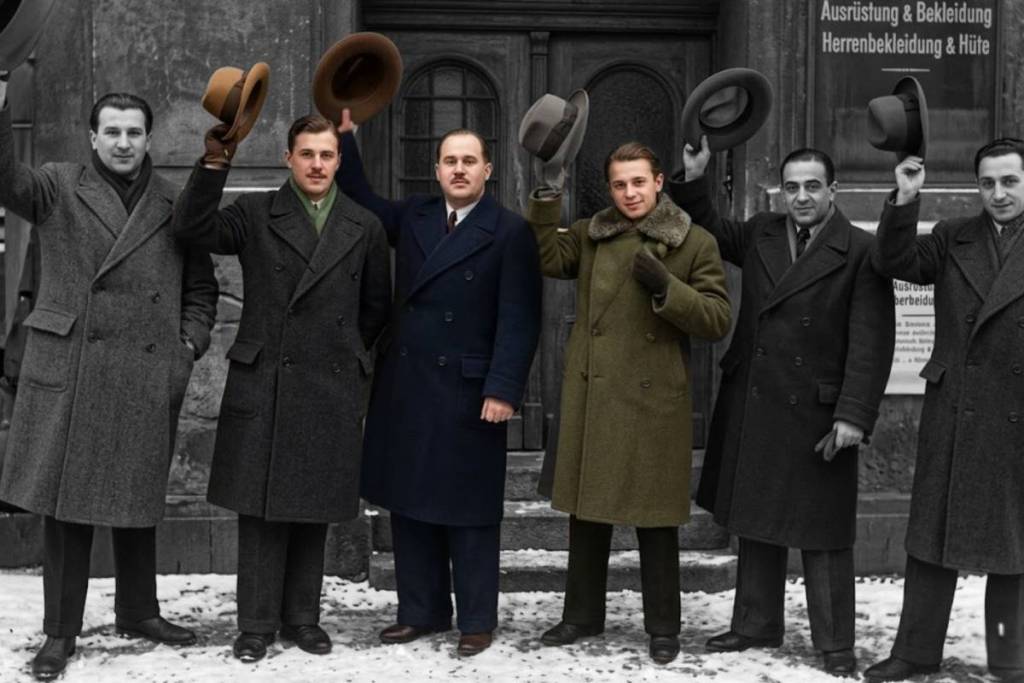
Frommermann, Cycowski, and Collin (see photo above) fled to Vienna and tried to make a fresh start. Together with a new pianist, a new bass, and a new tenor, Frommermann formed the “Comedy Harmonists,” who toured the world until 1941, when the U.S. entry into the war caught up with them in New York.
But neither of the two successor ensembles could recapture the former glory: the magic of those six voices was irreplaceable. Just how deep the rift ran became apparent decades later, when Biberti and Frommermann fought in court over the group’s authorship.
And today?

The story has never quite let go of Berlin. In 1997, Joseph Vilsmaier’s feature film brought the six back into the collective memory, and to this day their songs are sung, covered, and quoted.
Anyone strolling through Friedenau (perhaps following in the footsteps of another great figure) or walking along Friedrichstraße is moving through the backdrop of this story—and might even find themselves humming “The Little Green Cactus” along the way.
Are you interested in the history of the Comedian Harmonists? We’ve summarized their story with pictures and text in this Instagram post: