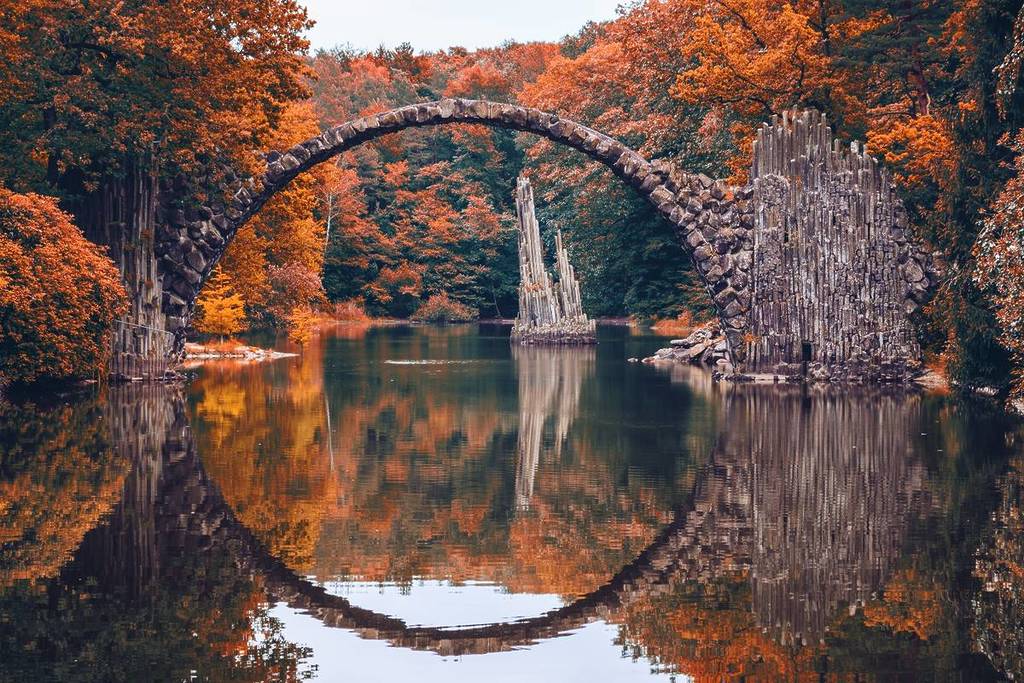
Everything is more beautiful in October: shades of gold, red and orange bathe places, squares and entire cities in a glorious world of color. It is the most beautiful time for walks and hikes in nature. Whether in Berlin’s many parks or at the city’s largest lake – just 20 km from the city center – autumn is at its best here. For a special excursion, there are real natural gems around Berlin that you should make a note of for an autumn weekend. There is variety for every taste: from relaxed canoeing in the “German Venice” to a walk along a 700-metre treetop path with panoramic views from above. And that’s just the beginning: about three hours from Berlin lies the Rakotzbrücke, whose perfect construction in the 19th century seemed so superhuman that it was also known as the “Devil’s Bridge”. Find out its mystical history and how it became a magical place in a famous movie here!
The unique structure
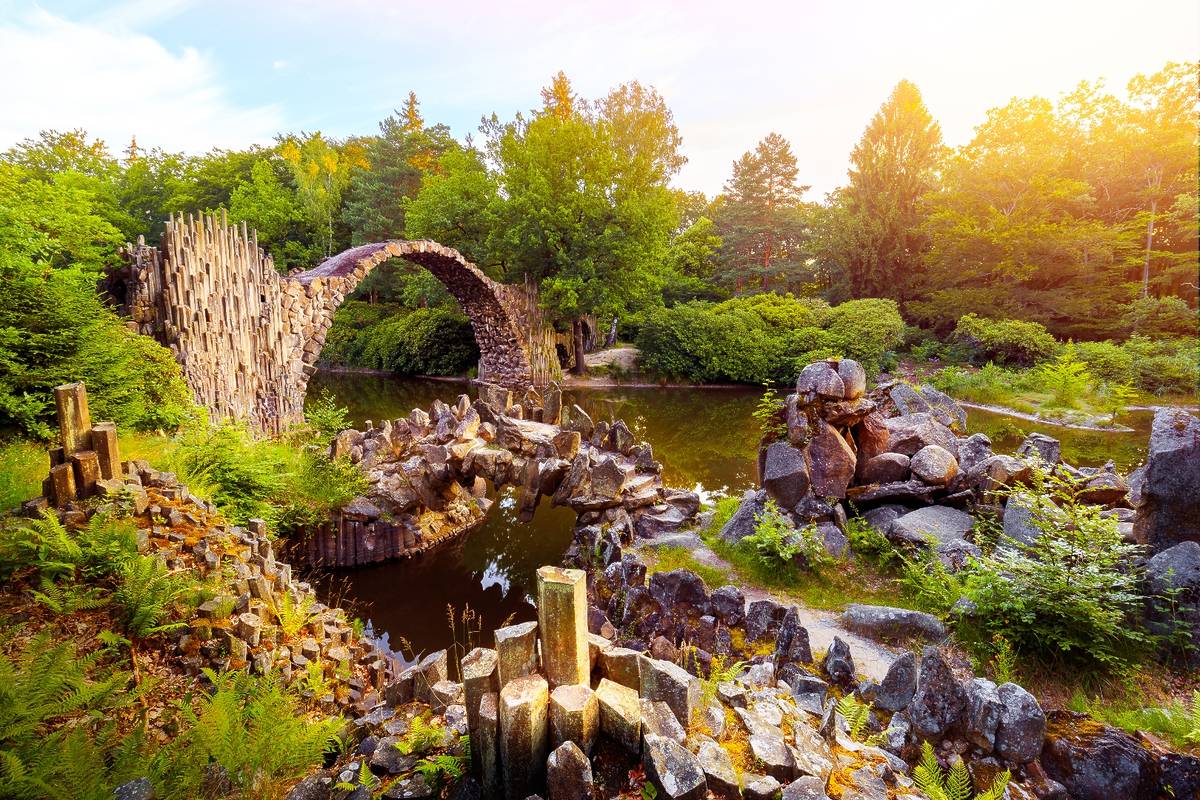
The Kromlau Rhododendron and Azalea Park in the small town of Gablenz in Saxony is home to an extraordinary bridge that was built between 1866 and 1875. Made entirely of basalt and field stones, the building blocks of the Rakotzbrücke are arranged so precisely that they not only offer enormous stability, but also form a perfect circle when reflected in the water. Built in the 19th century without modern machinery, the bridge was constructed entirely by hand – with wooden scaffolding, ropes and the finest stonemasonry.
Its dimensions (length: 19.8 m, span: 7 m, height: 6 m) make it a true technical masterpiece of its time. The park covers around 200 hectares and is one of the largest outdoor rhododendron parks in Germany. The bridge is stable solely due to its own weight – no mortar was used on the main arches. It is therefore no wonder that this structure is a listed building and is considered a special cultural monument in Saxony. Walking on the bridge is expressly prohibited – both for safety reasons and to protect the historic wall structure.
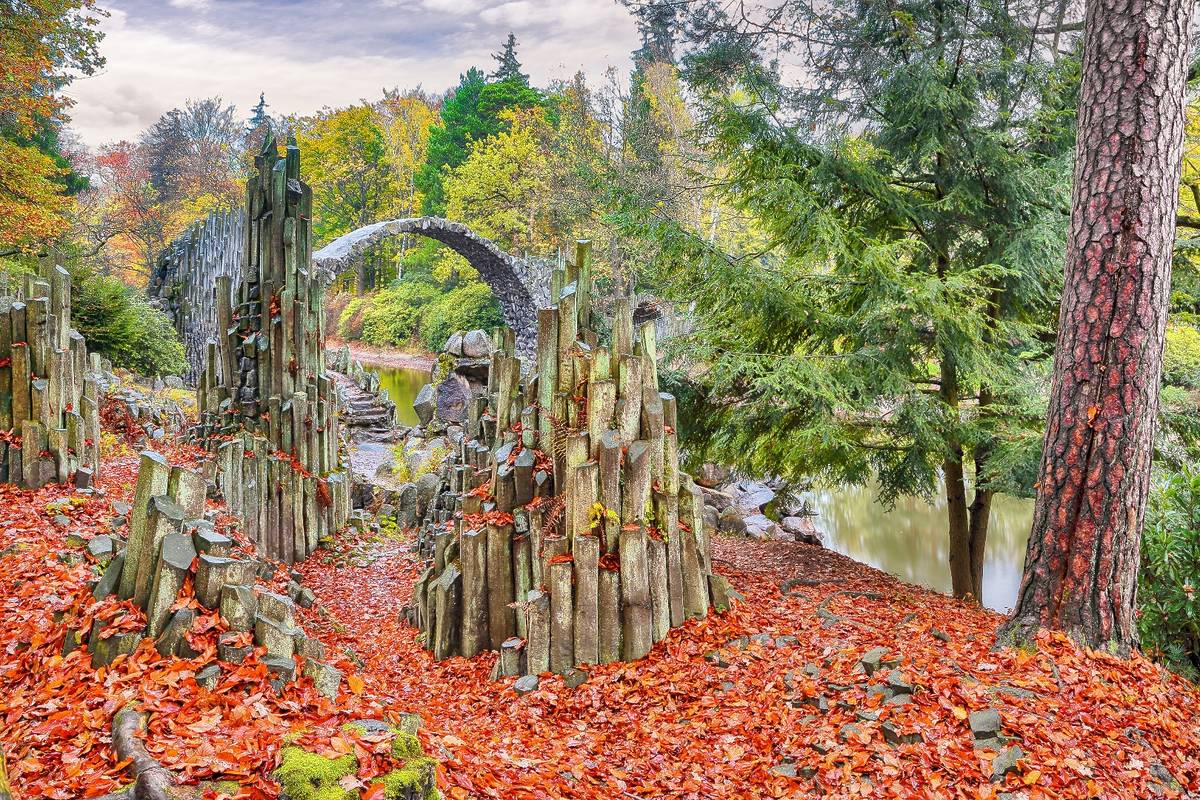
Is the Rakotzbrücke a “Devil’s Bridge”?
If you look at the bridge from the right angle – preferably from the south bank – its shape and the reflection in the water create an almost mathematically perfect circle. When there is no wind and the reflection is clear, the image appears surreal, almost supernatural. In the 19th century, this sight led to the name “Devil’s Bridge”. It was believed that only the devil could create something so perfect. According to legend, the master builder promised the devil the soul of the first creature to cross the bridge. To deceive him, however, he chased an animal across it – in some versions it was a dog, in others a goat or a chicken. The bridge’s atmosphere alone is unique – but with this legend in mind, it seems even more mysterious and magical.
Symbolism & use of the Rakotzbrücke
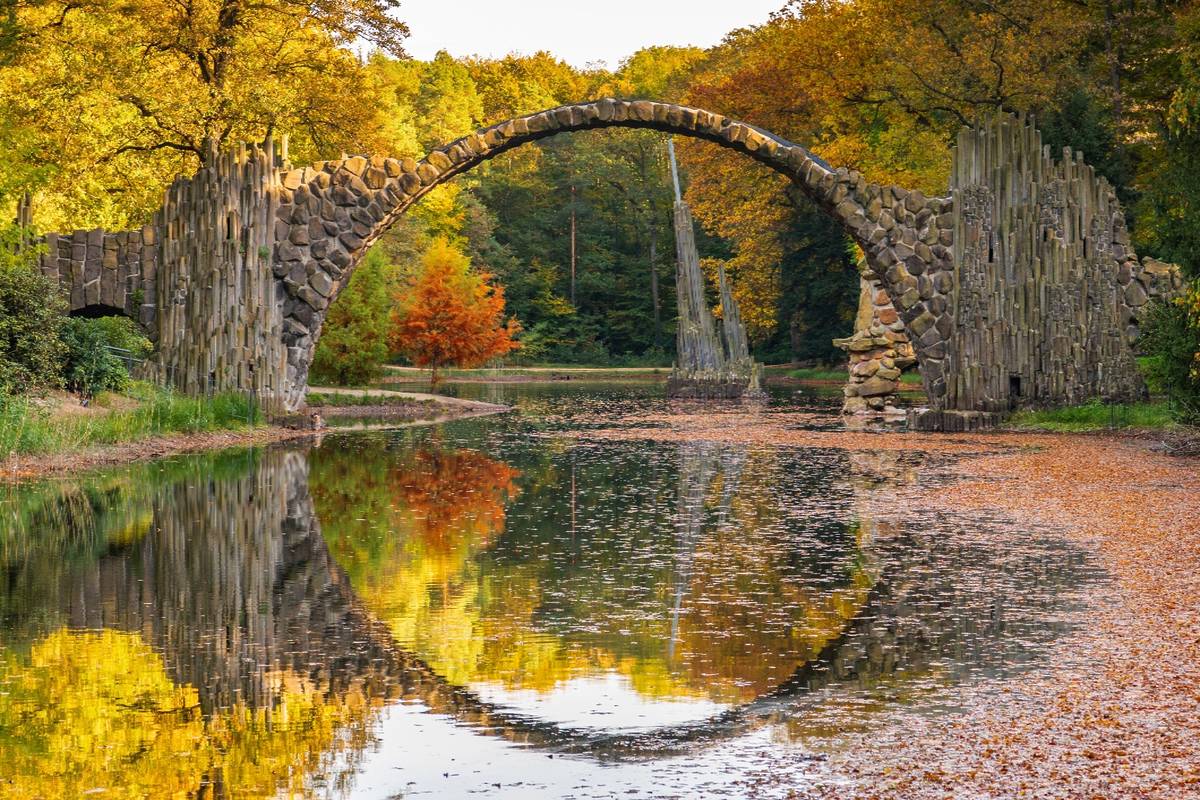
The Rakotzbrücke was not built for traffic, but as a symbolic work of art. In the Romantic era (19th century), it was seen as a symbol of the “sublime” – the human spirit trying to harmonize nature and art. The bridge stands for the transition between this world and the hereafter, between man and nature. The perfect interplay of reflection, stillness and form makes it a place of contemplation and wonder.
It is a popular motif in travel videos, drone shots and photo campaigns. For the German film “The Sorcerer’s Apprentice” (2017), it served as a magical gate through which you sail in a rowing boat. The bridge can also be seen briefly in the American film Matrix Resurrections (2021). If you want to experience the beauty of this bridge for yourself, you should visit it in the fall. When nature shines in warm colors, impressive photos are taken there. The best light conditions for photos are between 8-10 am and 4-5:30 pm. So it’s no wonder that the Rakotzbrücke is one of the most photographed motifs in Germany.
Benches and picnic areas around the lake invite you to linger. With a thermos flask and snacks in your luggage, you can enjoy nature to the full. In Kromlau or nearby Bad Muskau, you will also find cozy cafés and restaurants for a relaxing end to the day.