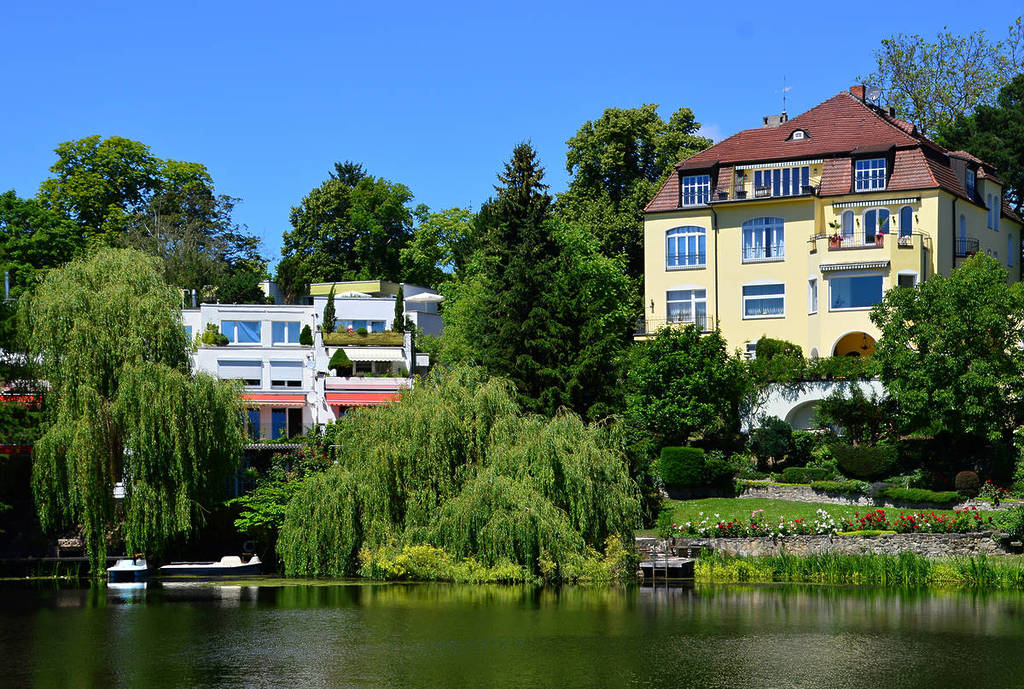
A walk through Berlin can be like a search for the most diverse celebrity apartments. David Bowie’s old flat share is in Schöneberg, and Marlene Dietrich’s birthplace can also be found in the middle of Berlin. Karl Lagerfeld has also left his mark on the capital. The spectacular “villa” associated with him is today’s Schlosshotel in Grunewald. It used to be known as Palais Pannwitz.
First things first: the Schlosshotel is not Karl Lagerfeld’s personal residence, but a historic property whose entire interior was exclusively designed by him in the 1990s. The hotel still bears his unique stamp to this day. If you want to experience special design, this is the place for you.
Extreme luxury and historical aesthetics
The building was built in 1912 as Palais Pannwitz in the Italian Renaissance style for the lawyer and art collector Walter von Pannwitz. At the time, it was one of the most expensive private residences in Berlin.
Decades later, in the mid-1990s, the listed palace was converted into a luxury hotel. And none other than Karl Lagerfeld was responsible for the entire interior design . He staged the building as a complete court palace. His extravagant style is unmistakable.
The interior design is characterized by extreme luxury. You will find velvet fabrics, mahogany furniture, marble fireplaces and valuable oil paintings. One of the hotel’s most exclusive suites is the “Karl Lagerfeld Suite”. It is completely furnished according to his designs and often offers a private balcony with a view of the palace garden.
A hotel with the “celebrity factor”

The hotel became famous throughout Germany in 2006 when the German national soccer team stayed there during the World Cup. You may remember that the famous note used by goalkeeper Jens Lehmann in the penalty shoot-out against Argentina bore the signature of the “Schlosshotel im Grunewald”.
And although the Schlosshotel is centrally located in the Grunewald district of Berlin, it is surrounded by a large, park-like garden. There is only the best for the many prominent guests. And that also means peace and seclusion away from the hustle and bustle of the city.
The house itself has had an eventful history: from a private Renaissance palace to its use as an embassy to a hotel. Lagerfeld’s design is just one of the many extraordinary layers of this historic place.