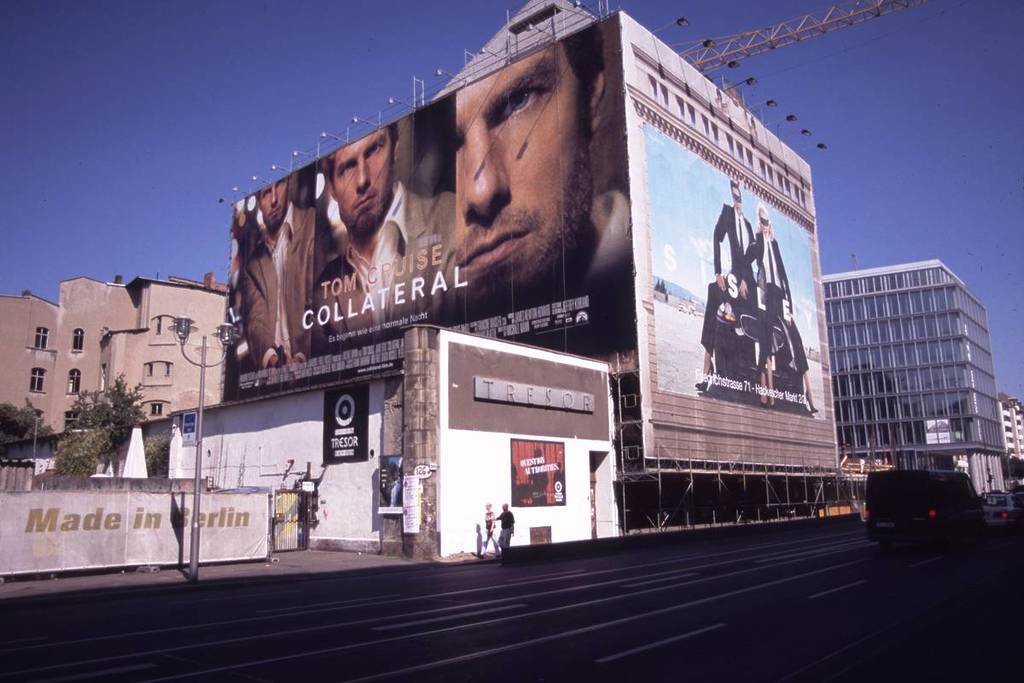

Amidst the rubble after the fall of the Wall in 1989, Dimitri Hegemann came across an abandoned place in Berlin-Mitte on Leipziger Straße in 1991: the former vaults of the Wertheim department store. Once one of the largest and most elegant department stores in Europe, only the cellar remained after the war. Where money and jewelry used to be stored, there was now a labyrinth of thick steel doors, rusty walls and dark corridors. Hegemann recognized the potential of this unusual place and opened the Tresor Club there together with friends in March 1991.
The architecture was anything but ordinary: even the entrance led through an inconspicuous door into a former air raid shelter. Behind it were raw concrete walls, barred doors, the smell of metal and flickering strobe lights. And the music? Matching the industrial flair: hard, hypnotic techno beats from Detroit and Berlin. The Tresor quickly became the cradle of Berlin techno – a place where East and West came together and artists and night owls from all over the world formed a completely new scene.

What made Tresor so special was its atmosphere of ruin, rebellion and freedom – the perfect stage for a culture that wanted to push boundaries. Many of those who went on to make techno history played here – including Jeff Mills, Juan Atkins, Sven Väth, Ellen Allien and many others. The Tresor quickly became a symbol of a new Berlin. In 2005, the club had to close at its original location because the site was being used for building projects. But the Tresor could not simply be wiped out: in 2007 it was revived on Köpenicker Straße in Kreuzberg, just like Berghain in a former thermal power station. The spirit of that time – industrial, dark and mysterious – lives on there to this day, just in a different location.