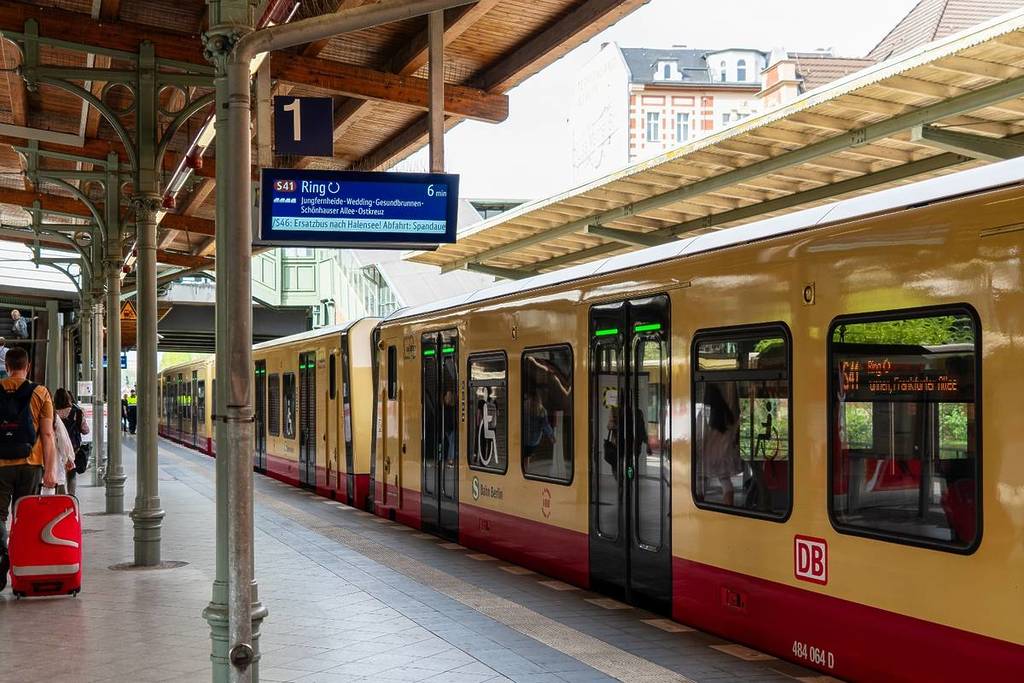
Our capital is known for hiding a surprisingly strategic past behind many of today’s popular places. Whether in public transport or leisure culture, Berlin combines past and present in a unique way. The rooms of some of the most famous techno clubs, for example, were not originally built for nightlife. Berghain was once a thermal power station, Tresor used the old vaults of a department store. It’s hard to believe what Berlin has done with its former industrial buildings! But not only clubs, even seemingly ordinary places tell of another time. The Pankstraße subway station, for example, still conceals a nuclear bunker that once had room for 3,300 people – amazing when you consider that thousands of passengers pass by here every day without knowing it. And the Berlin Ringbahn, which today forms the inner city ring, also has a military past: the approximately 37-kilometre-long line was not built for passenger transport in the 19th century, but for purely strategic reasons for the war.
In the 19th century, when Berlin became the capital of Prussia and later the German Empire, the Prussian military demanded the construction of its own railroad line. It was to be used to transport troops and war material quickly around the city – without blocking the busy city center. The idea was to move soldiers, weapons, horses and supplies efficiently between barracks, depots, railroad stations and strategic points – in the event of war or insurrection, for example. Construction of what would later become the S-Bahn ring line began in 1851, and the first sections went into operation in the same year and the following year – initially exclusively as a freight and military line. It connected important military and industrial areas outside the city center, such as Moabit, Tempelhof, Rummelsburg and Pankow. From the 1870s, the line was also increasingly used for passenger transport. The Ring was finally closed in 1877 – a technical and logistical masterpiece of its time.
The Ringbahn was considered a “bypass line” for the Prussian army: It allowed supplies to be transported around the city, mobilizations to be accelerated and the inner-city traffic routes to be relieved. With Berlin’s rapid growth in the 19th and 20th centuries, the Ringbahn soon became indispensable for everyday life. It connected city districts and new residential areas, brought economic growth and formed the basis for today’s Berlin S-Bahn network. It was electrified in 1926 and became known as the S-Bahn Ring. Today, hundreds of thousands of passengers use the Ringbahn every day – mostly without knowing that they are traveling on a relic of Prussian military strategy.