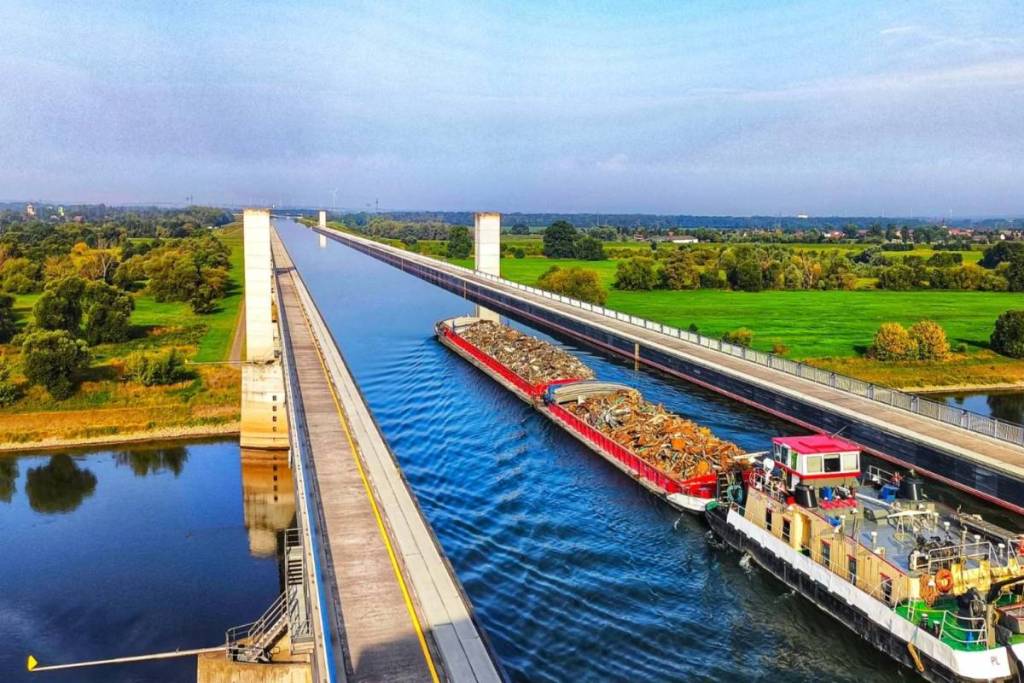

In addition to the three bridges between Frankfurt (Oder) and Słubice in Poland, there are other extraordinary bridge structures to discover not far from Berlin. One of them is the Magdeburg Canal Bridge: It carries the Mittelland Canal over the Elbe River and allows cargo ships to cross a river via a bridge.
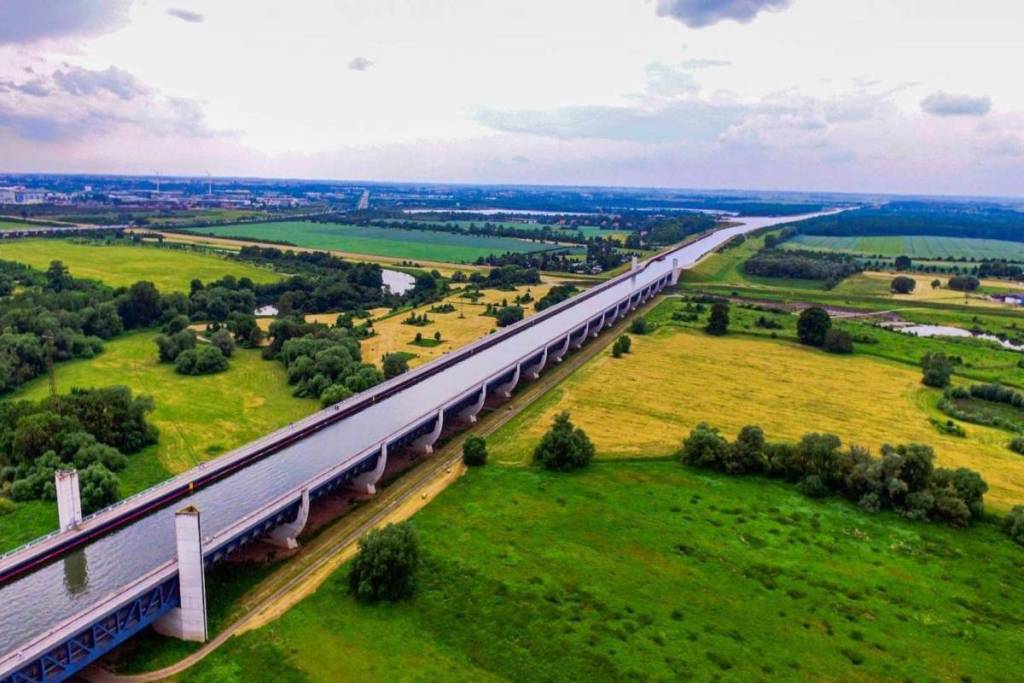
The ships travel through a steel trough filled with water, while the Elbe flows several meters below them and can also be navigated by ships. East of the Elbe, the route continues via the Elbe-Havel Canal. This created a direct waterway connection between western and eastern Germany.
The dimensions of the structure are immense. The canal bridge is 918 meters long and 43 meters wide. The trough usable for navigation is 32 meters wide, while the structure’s maximum span is 106 meters . Approximately 24,000 metric tons of steel and 68,000 cubic meters of concrete were required for its construction. By way of comparison: About 7,300 metric tons of iron were used to build the Eiffel Tower. The amount of steel in the Magdeburg Canal Bridge alone is thus more than three times that weight. At 918 meters, the Magdeburg Canal Bridge is considered the longest canal bridge in the world. Guinness World Records also lists the structure as a record holder.
The history of this extraordinary structure goes back a long way. As early as the beginning of the 20th century , there were plans for a direct connection between the waterways. Construction of the Mittelland Canal began in 1905, and work on a canal bridge across the Elbe finally began in the 1930s. The project was already well underway when construction was halted in 1942 due to World War II. Parts of the foundations and the structure had already been completed by that time.
After the war ended, however, the project was not continued in the GDR. The remains of the unfinished structure therefore stood along the Elbe for decades. It was not until after German reunification that the idea of a canal bridge was taken up again. Thus, today’s structure also embodies a piece of German history: an infrastructure project begun before the end of World War II was not completed until decades later.
In the 1990s, planning for the connection was resumed. In 1998, construction finally began on the current canal bridge. After about five years of construction, it was opened to traffic on October 10, 2003. The canal bridge alone cost about 130 million euros. More than 500 million euros were invested in the entire Magdeburg waterway junction.