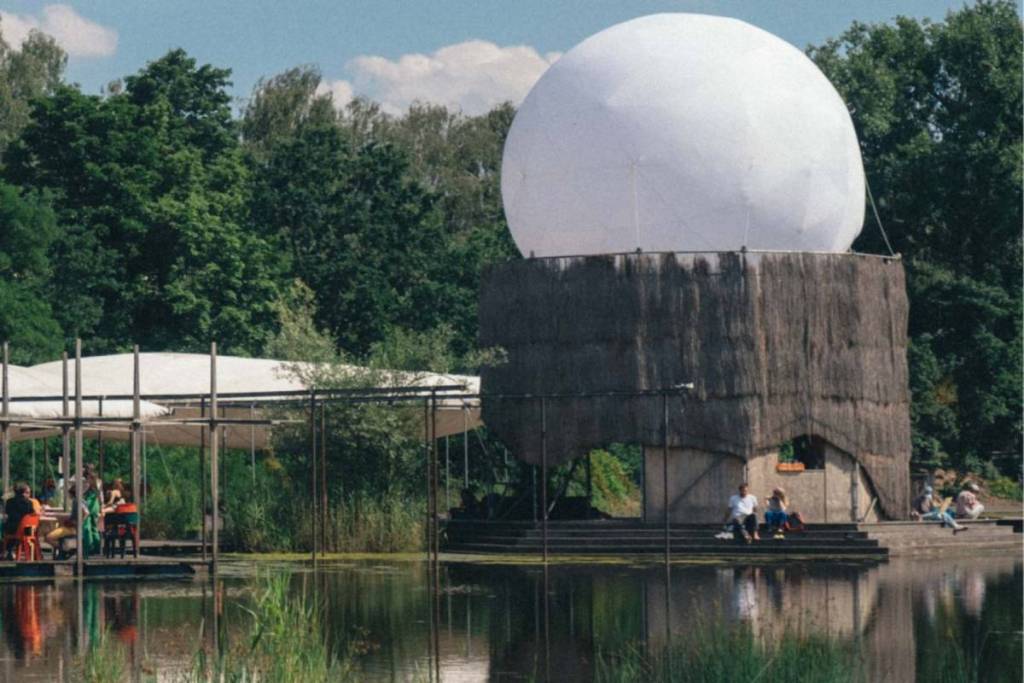

Everything is simply better on or in the water—whether it’s cooling off in a swimming lake, romping around at a water playground, or even learning. An extraordinary place in the heart of Berlin demonstrates just how the latter works in a very special way. Despite its name, the Floating University is not a university in the traditional sense. Rather, it sees itself as a “Natureculture Learning Site”— a place where nature and culture come together to foster learning. Since 2018, urban nature, architecture, art, research, education, and collaborative experimentation have converged here.
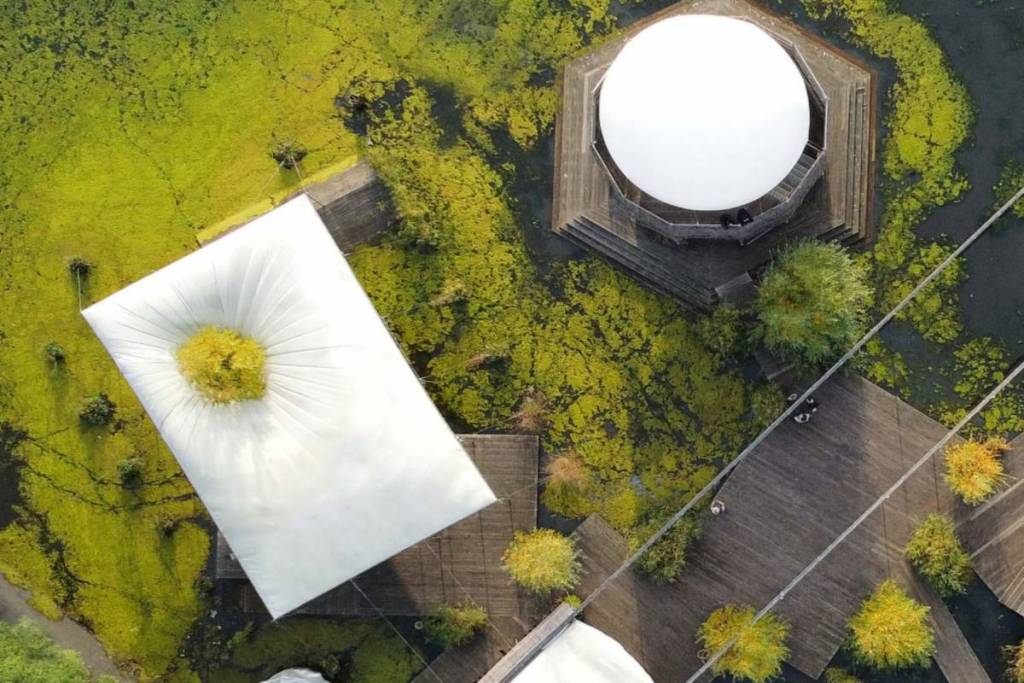
The location is particularly extraordinary: The Floating University is situated in a rainwater retention basin at the former Tempelhof Airport in Kreuzberg that is still in operation. The address is Lilienthalstraße 32, 10965 Berlin. The entire site covers approximately 22,500 square meters. The stormwater retention basin was originally constructed in the early 1930s for the former Tempelhof Airport and the adjacent streets. After World War II, the U.S. Army had the basin lined with concrete. It continues to fulfill its original function to this day. When it rains, water collects there and is then channeled into Berlin’s sewer system . This unusual setting is therefore not a structure built retroactively for the cultural project, but rather genuine Berlin water infrastructure.
For more than 80 years , the rainwater retention basin was closed to the public. During this time, an unusual landscape developed right in the heart of Berlin. Plants, algae, and various animal species settled there, gradually transforming the originally purely technical infrastructure into a small urban ecosystem. In addition, the site is surrounded by community gardens and is barely visible from the outside. Although it is located right next to the former Tempelhof Airport grounds, it is actually a rather hidden spot.
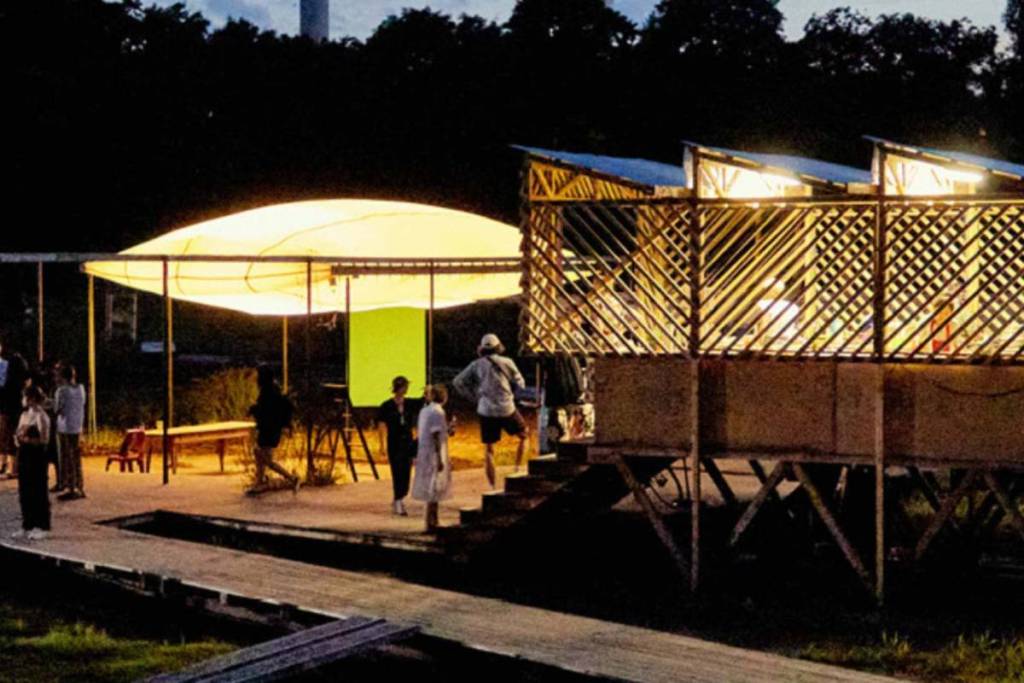
The architectural group raumlaborberlin discovered the site while conducting research for a project on the former airport grounds. In 2018, the rainwater retention basin was finally opened to the public as the Floating University. Since then, the site has served as a place to explore and experiment with how architecture, nature, people, animals, and urban infrastructurecan coexist. The term “University” refers less to a traditional educational institution than to the idea of an open space for learning, research, and experimentation.
By 2026, the Floating University will have been in existence for eight years. In keeping with this milestone, the exhibition “Living Infrastructure” explores the site’s development. Photographs, films, objects, and stories illustrate how the technical water facility has evolved into an ecological and social space for experimentation. The exhibition runs through September 27, 2026. Nature itself is a key component of the concept. The site is home to amphibians and microorganisms, among other species, while algae, reeds, and other plants have spread around the water. During open hours, visitors can simply spend time on the grounds, observe the unusual vegetation, or keep an eye out for frogs. Community meals, concerts, film screenings, and other events are also held regularly.
You don’t necessarily have to participate in a workshop to visit. During regular opening hours, you can explore the grounds on your own. In addition, there is a rotating program of workshops, exhibitions, guided tours, art projects, movement activities, and various educational formats. These include, for example, “Space for Practice.” Through October 12, 2026, an open movement session takes place every Monday from 9 to 11 a.m. right in the rainwater retention basin. Registration is not required, and participation is free. The Floating Kidsuni also offers a special program for children, where they can engage with water, architecture, urban development, art, and nature in a playful way.
The topic of water plays a particularly important role. The rainwater retention basin is used to teach topics such as climate change, water management, and the concept of the so-called “sponge city” in a hands-on way . Among other things, this involves exploring how rainwater in cities can be stored and used locally or allowed to infiltrate the ground, rather than being drained as quickly as possible through the sewer system. The Floating University thus uses a real-world example to demonstrate how technical infrastructure, biodiversity, climate adaptation, and urban life can be interconnected.