
Berlin is a paradise for art lovers all year round. Exciting exhibitions can be found throughout the city, while major artists come to the capital to present their extraordinary works. And as of yesterday, it’s that time again: Maurizio Cattelan , one of the most famous contemporary artists, is presenting a major solo exhibition in Germany for the first time. “NIGHT” is on view at the Neue Nationalgalerie at the Kulturforum and brings some of his most provocative works to Berlin.
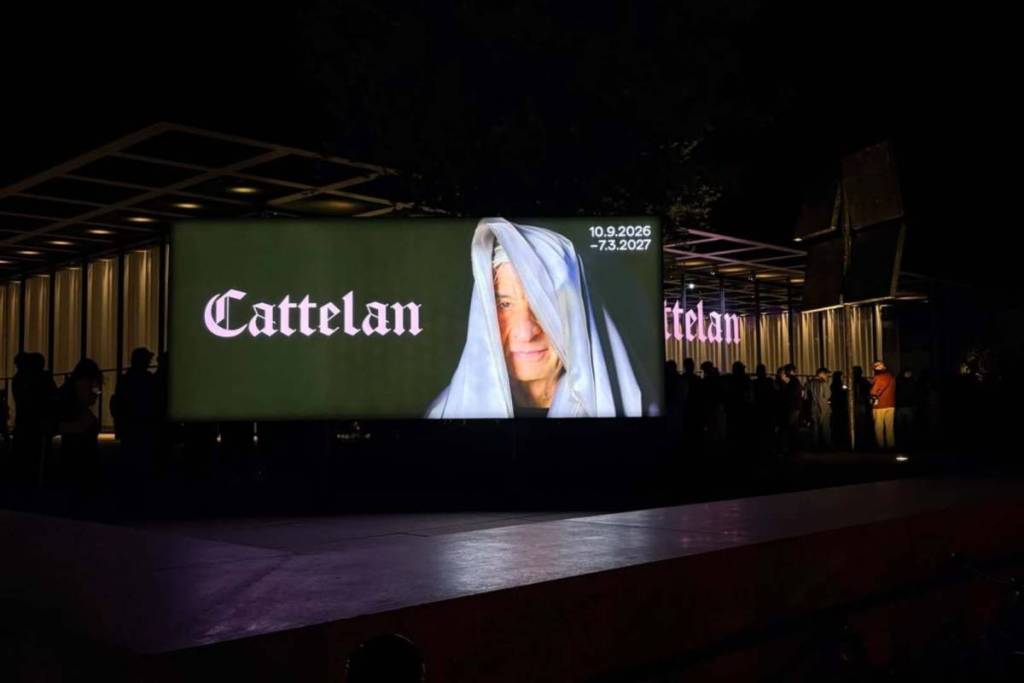
It combines some of his most famous earlier works with new pieces created specifically for the exhibition. A total of 17 works are distributed throughout and around Mies van der Rohe’s glass hall. In these works, Cattelan focuses primarily on German and European history, authority, violence, religion, death, memory, and collective trauma. Especially against the backdrop of German history, a number of his already provocative works take on additional significance in Berlin. The Neue Nationalgalerie describes his art as a interplay between irony and provocation that challenges established notions of memory, faith, and social power.
The exhibition is also linked to the 2026 National Gallery Prize. Cattelan was selected by an international jury; “NIGHT” is curated by Lisa Botti in collaboration with the director of the Neue Nationalgalerie, Klaus Biesenbach. One of the most striking works in “NIGHT” awaits visitors right at the start of the exhibition. For “Purgatory” (2026), Maurizio Cattelan has recreated a scaled-down version of the Brandenburg Gate and placed it inside the Neue Nationalgalerie. The Berlin landmark is thus removed from its familiar surroundings and becomes a symbolic threshold between the outside world and the exhibition. The title “Purgatory” refers to a place of transition and pause. The miniature Brandenburg Gate thus serves not merely as a spectacular backdrop, but as an introduction to the exhibition’s darker themes.
Anyone walking through the glass hall of the Neue Nationalgalerie becomes the object of observation themselves. For his new work “People” (2026), Cattelan has placed 4,000 taxidermied pigeons on the hall’s ceiling structure. The birds sit high above visitors’ heads and seem to be intently watching the activity below them. In doing so, Cattelan turns the usual situation in a museum on its head. Not only do people view the artworks, but visitors themselves get the feeling of being watched by thousands of eyes. Pigeons are not a new motif in Cattelan’s art; they have been appearing in his works for decades. In the open architecture of the Neue Nationalgalerie, however, the motif now takes on a monumental dimension.
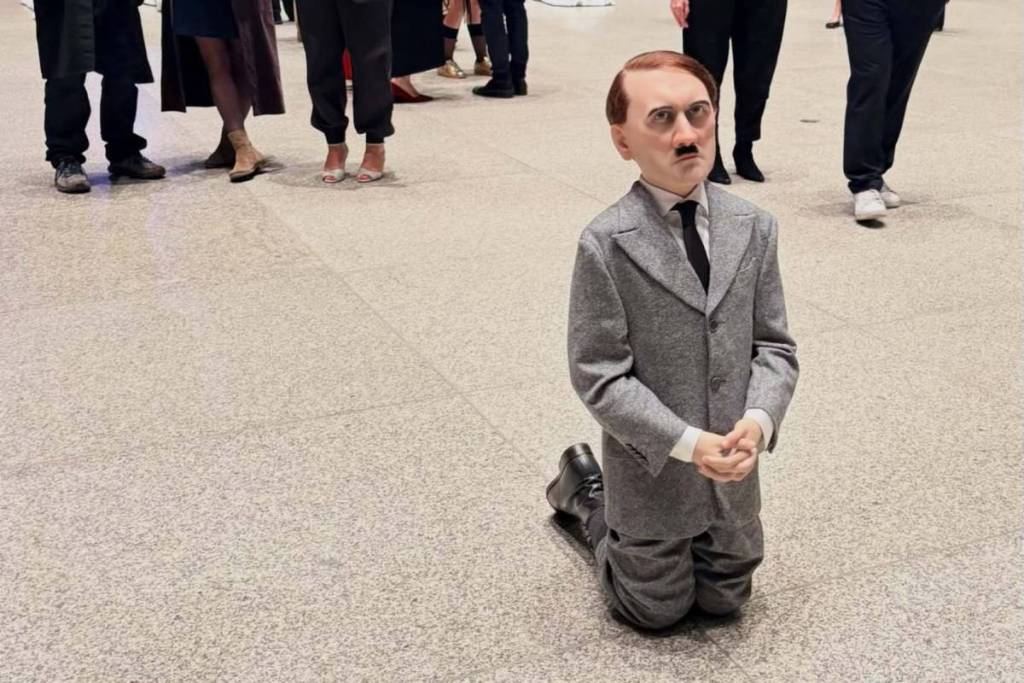
Among the most controversial works in the exhibition is “Him” from 2001. Viewed from behind, the sculpture initially resembles the figure of a young boy or a kneeling man who appears to be praying. Only when walking around it does it become apparent that the figure bears the facial features of Adolf Hitler. In “NIGHT,” “Him” forms a central axis within the glass hall together with “Dawn” (2007). Among other things, this juxtaposition explores themes of devotion and vulnerability. It is precisely through the presentation of this internationally renowned and much-discussed work in Berlin that it takes on a particularly charged historical context.
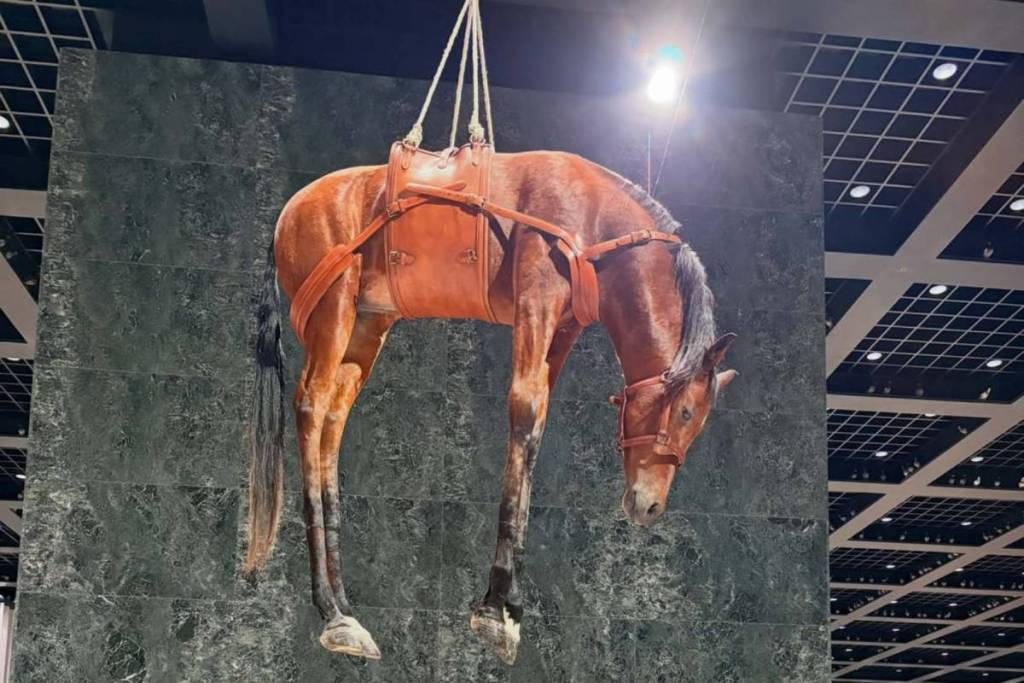
Animals repeatedly play an important role in Cattelan’s works. Among the pieces on view in Berlin is “Novecento” from 1997. The work depicts a taxidermied horse suspended from the ceiling by straps. Instead of standing powerfully on its legs, its body hangs motionless in the room with its head bowed. With “Novecento,” Cattelan brings one of his well-known earlier works to Berlin and juxtaposes it with new pieces. Together with the thousands of pigeons and other animal motifs, this creates an exhibition in which life and death, movement and stillness repeatedly collide.
Among the works created specifically for the Berlin exhibition is “After” (2026). The installation consists of a six-meter-long iron pipe, at the center of which is the figure of a sleeping dog . At regular intervals, the pipe is struck and begins to ring like a large bell. Through the unusual combination of the seemingly peacefully sleeping animal and the massive metal structure, Cattelan explores themes such as time, death, and memory.