


Just over an hour’s drive from Berlin, on Lake Scharmützel in Bad Saarow, stands a house where boxing world champion Max Schmeling once lived. Today, the Krauskopf-Schmeling House rents out three guest apartments, which include a fireplace room, a library, and a swimming pool in the garden. You can spend your vacation here for 228 euros per night.
Like many prominent Berliners, Schmeling had a second home in the surrounding area of the Mark in the 1930s. The house had previously belonged to the Expressionist painter Bruno Krauskopf, who fled into exile to escape the Nazis.
In 1933, Schmeling married the actress Anny Ondra in Bad Saarow; the house served as their retreat until 1938. He is said to have remarked later that those were the most carefree years of his life. From Bad Saarow, we look back on Max Schmeling’s years in Berlin.
Max Schmeling: A Boxer in Berlin

Schmeling’s life began modestly: born in Klein Luckow in the Uckermark in 1905, he grew up in Hamburg. In 1924, the young boxer moved to Berlin, the city of the Roaring Twenties. Here, every fight night was a social event.
He became the German light heavyweight champion, then the European champion. Actors, painters, and writers sought his company. In 1930, he became the first German heavyweight world champion in New York, following the disqualification of his opponent, Jack Sharkey.
The enemy is our own question in the form of a figure

In 1936, he knocked out the previously undefeated Joe Louis in the twelfth round. The Nazi leadership celebrated the victory over the Black American as proof of their racist ideology.
Although Schmeling did not share this ideology and never joined the NSDAP, he did allow himself to be photographed with Nazi leaders and took advantage of the privileges afforded to a sports idol. At the same time, he resisted pressure to part ways with his Jewish-American manager, Joe Jacobs. He remained loyal to him until Jacobs’s death in 1940.
In the rematch against Joe Louis in 1938, he lost after just 124 seconds, and the regime turned its back on him. On Kristallnacht in November, he hid the Jewish brothers Heinz and Werner Lewin in his Berlin hotel room. Later, he helped them flee to the United States. This wasn’t made public until 1989 by one of those who had been saved.

In 1940, he was drafted into the Wehrmacht as a paratrooper, a move often interpreted as a punitive measure; in 1941, he was seriously wounded during the Battle of Crete. In 1947, he was cleared of any wrongdoing in the British denazification proceedings.
After a brief comeback, he built a new life for himself in Hamburg as a Coca-Cola bottler. His rivalry with Joe Louis had long since turned into a friendship. When former world champion Louis fell on hard times financially, Schmeling helped him for years.
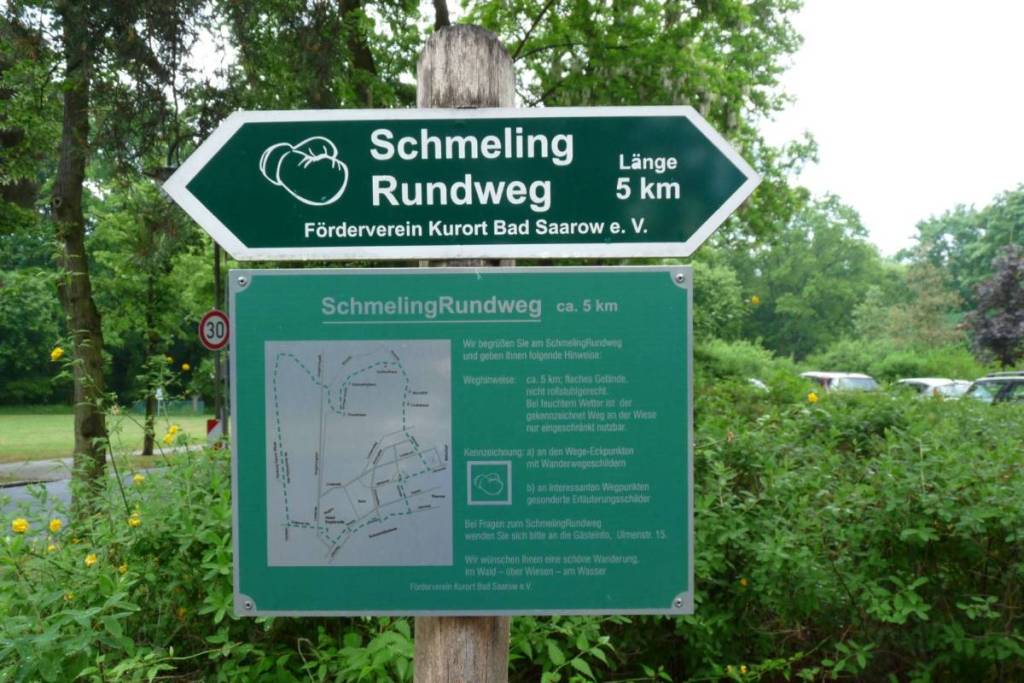
Max Schmeling died in 2005 at the age of 99. In Berlin, the Max-Schmeling-Halle in Prenzlauer Berg has borne his name since 1996. Anyone staying overnight in Bad Saarow can follow in Schmeling’s footsteps on foot: a loop trail with green information signs leads from the harbor along the lakeside promenade to the church where the couple was married, and past the Krauskopf-Schmeling-Ondra House.
But be careful! ⚠️ The Scharmützelsee (with an “a”) near Bad Saarow should not be confused with the small Schermützelsee (with an “e”) in Buckow.
