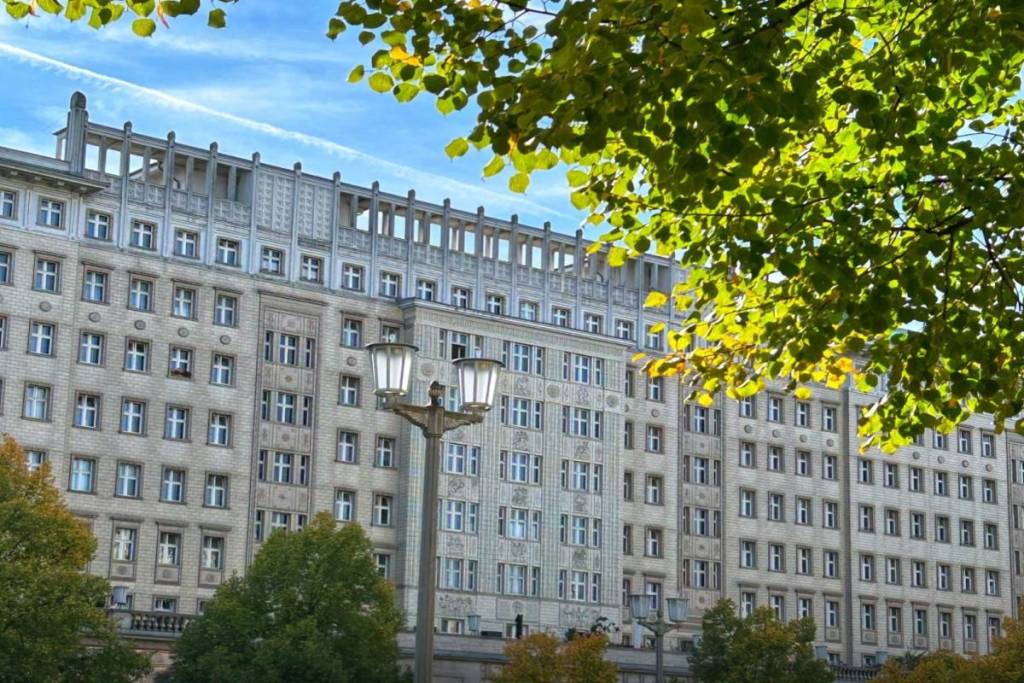

What seems so peaceful and unassuming today was once the scene of war, destruction, and political division. While today you can stroll past Checkpoint Charlie in complete relaxation, in 1963 a man attempted a spectacular escape from the GDR right here. Berlin is full of fascinating stories from the past, traces of which are still visible in the cityscape today. And we certainly don’t want to keep such stories from you! This time , our historical journey takes us to Karl-Marx-Allee, one of the capital’s most historic streets. Hardly any other place tells the story of the rise, power ambitions, and contradictions of the GDR so vividly.
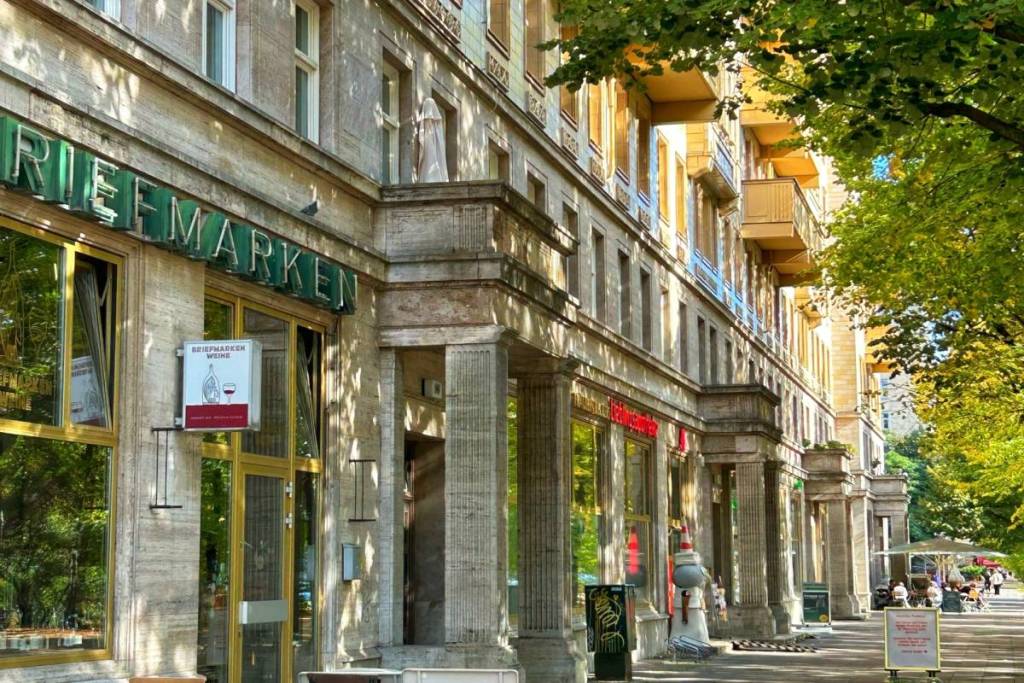
What is today an imposing boulevard with monumental buildings, wide sidewalks, and striking architecture was once a scene of war, destruction, socialist megalomania, and political resistance. In the spring of 1945, during the final weeks of World War II, what was then known as Große Frankfurter Straße became one of the battlegrounds of the Battle of Berlin. Soviet troops advanced toward the city center via this eastern approach road. The fighting left behind severe destruction; entire rows of houses lay in ruins. The cleanup of war damage and the subsequent reconstruction continued well into the 1950s.
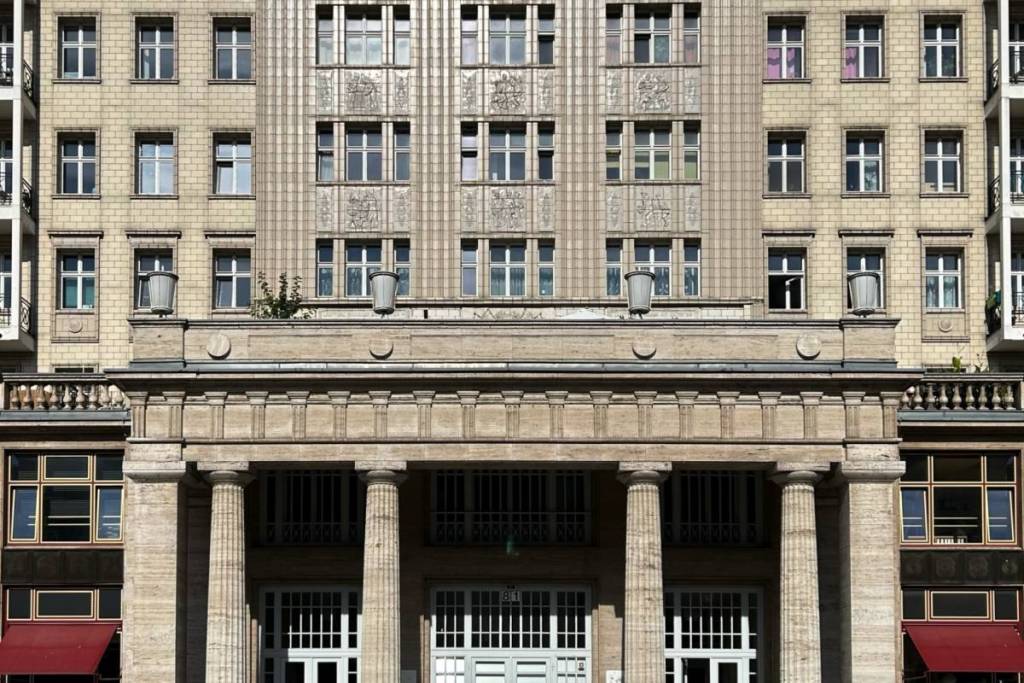
But the young GDR had ambitious plans for the street. The ruins were not simply to be transformed into a new residential neighborhood, but into an architectural symbol of socialism. The government wanted to build the “first socialist street on German soil” here, thereby demonstrating the superiority of the new political system. As early as December 21, 1949, Große Frankfurter Straße was renamed Stalinallee to mark Josef Stalin’s 70th birthday. Beginning in 1952, monumental residential palaces in the style of socialist classicism were built along the boulevard. The magnificent facades, wide streets, and imposing buildings were modeled after Soviet examples. Particularly striking were the two towers at Frankfurter Tor, which continue to shape the cityscape to this day.
With a width of around 90 meters in some places, the street was intended not only to provide spacious living quarters but also to serve as a prestigious backdrop for political marches and military parades. At the same time, apartments were built that were exceptionally comfortable by the standards of the time. Some featured hardwood floors, central heating, elevators, and spacious floor plans of up to 145 square meters. As early as 1951, a monumental statue of Stalin was erected along the street, further underscoring the political character of this prestigious project.
But behind the magnificent facade, tensions were simmering. On June 16, 1953, construction workers on Stalinallee protested against the increase in work quotas, which effectively meant more work without corresponding additional pay. The protests escalated the following day into the popular uprising of June 17, 1953, which spread to numerous cities across the GDR . Among other things, the demonstrators demanded better living conditions, political freedom, and free elections. Soviet troops and GDR security forces violently crushed the uprising.
The street, which was actually meant to embody the strength of socialism, thus became—of all places—a starting point for resistance against the GDR regime. In November 1961, the name “Stalin” finally disappeared from the streetscape. As part of the de-Stalinization process, the section between Alexanderplatz and Frankfurter Tor was renamed Karl-Marx-Allee. The section to the east was renamed Frankfurter Allee. The Stalin monument was also removed. This marked the end of a significant chapter in the history of the magnificent socialist boulevard.
Today, Karl-Marx-Allee is one of Berlin’s most impressive historic boulevards. Stretching about 2.5 kilometers, it connects Alexanderplatz with Frankfurter Tor and runs through the districts of Mitte and Friedrichshain. The monumental apartment buildings, ornate facades, and wide streets still serve as a reminder of the GDR’s ambitious construction projects.