

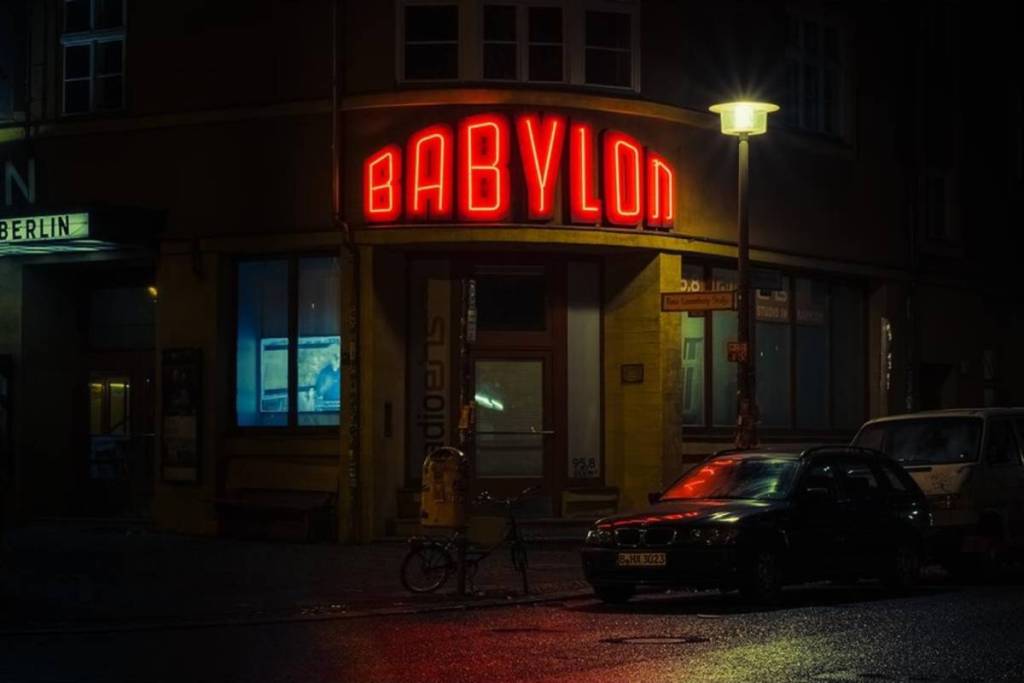
There is certainly no shortage of extraordinary movie experiences in the capital. From a theater where you’re served an exclusive 16-course meal to complement the film to unique cinemas with very special concepts —movie fans can always discover something new in Berlin. But some movie theaters not only offer an extraordinary lineup but also boast a fascinating history. Among them is the historic Babylon Theater on Rosa-Luxemburg-Platz in Berlin-Mitte, one of the capital’s most famous historic movie theaters. Since its opening in 1929, it has witnessed numerous political, social, and cultural changes and remains a truly unique gem to this day.

Particularly remarkable is its historic cinema organ from the silent film era, which is still used for film screenings today. While many other movie theaters have long since lost their original features, visitors to the Babylon can still experience how films were accompanied by music before the advent of sound films. This makes the theater not only an important architectural testament to Berlin’s history, but also a place where an almost forgotten cinematic tradition has remained alive .
The Babylon cinema was built between 1928 and 1929 based on designs by the renowned architect Hans Poelzig, who is considered one of the most important figures in modern architecture in Germany. The building complex was constructed on what was then Bülowplatz—now Rosa-Luxemburg-Platz—and was designed in the New Objectivity style. On April 11, 1929, the cinema opened its doors for the first time and impressed audiences with facilities that were state-of-the-art for the time. The auditorium could seat a total of 1,299 people, including the boxes and the balcony. The facilities also included an orchestra pit and an innovative cinema organ that had been specially developed to provide musical accompaniment for silent films.
Unlike many of the major premiere theaters in West Berlin, the Babylon was not initially a classic premiere venue but was primarily aimed at moviegoers in East Berlin. Nevertheless, it developed into an important part of Berlin’s cinema scene and became a popular meeting place for film enthusiasts.
One of the Babylon’s most distinctive features is the historic Philipps cinema organ from 1929. At the time of its installation, it was considered the largest German cinema orchestra organ and represented a technical sensation. The instrument featured a total of 913 pipes, 66 stops, two manuals, a pedal, as well as 137 sound parts and 34 sound effects. This extensive array of features enabled a single organist to provide the musical and acoustic accompaniment for an entire silent film.
Unlike a typical church organ, the movie theater organ could not only produce various musical timbres but also imitate numerous everyday sounds. These included, for example, the clatter of horses’ hooves, telephone rings, car horns, fire alarms, and birdsong. In this way, the events on the screen could be immediately accompanied by music and sound effects. For audiences at the time, this created a particularly impressive cinematic experience that compensated for the lack of spoken dialogue and the absence of synchronized sound effects in films.
A particularly significant moment in the Babylon’s recent history was May 26, 2001. On that day, the restored cinema organ was played in public for the first time, during a screening of the silent film classic *Der Golem, wie er in die Welt kam* (*The Golem: How He Came into the World*). This marked the return of an essential element of the cinema’s original atmosphere.