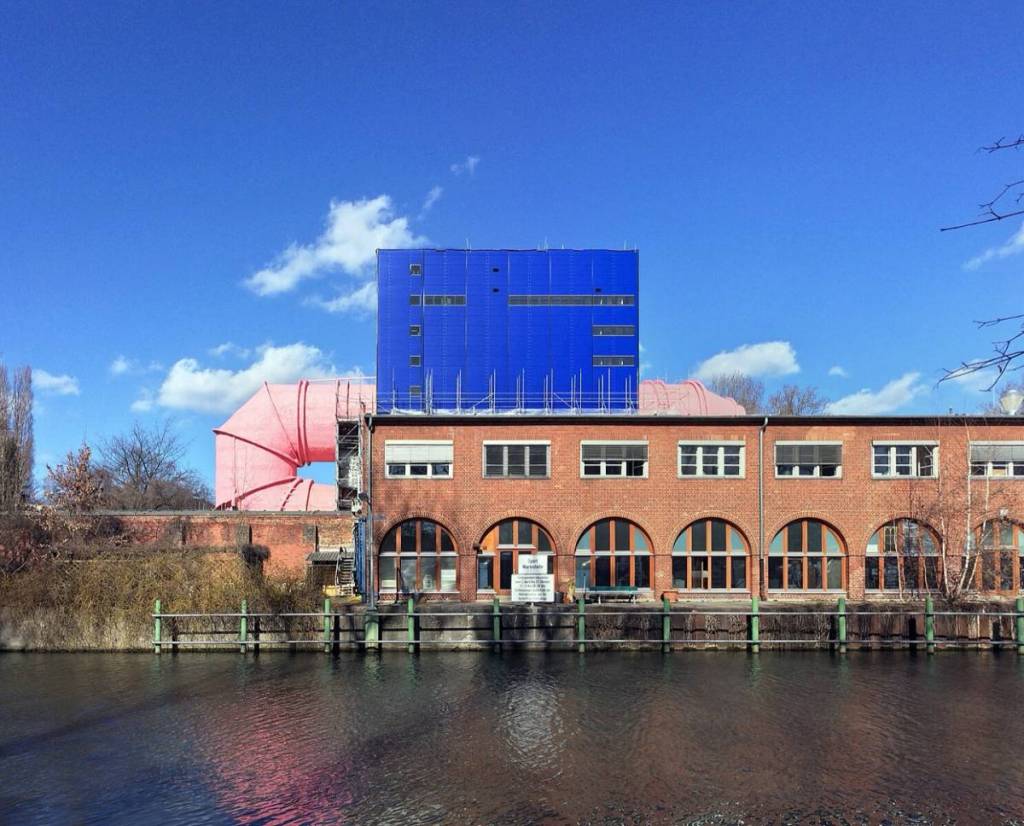

Impressive buildings and extraordinary architecture are no rarity in Berlin. A Berlin bunker that was known about 30 years ago as the “hardest club in the world” because of its fetish and fantasy parties is just one of many unusual highlights you can discover in the city. And if you want to explore even more spectacular buildings, you’ve come to the right place. Today we’re featuring a particularly eye-catching example: a huge pink tube winds around and through an angular, blue-clad structure. Behind it lies Umlauftank 2—UT2 for short—a research facility of the Technical University of Berlin located on Schleuseninsel at the edge of the Tiergarten.
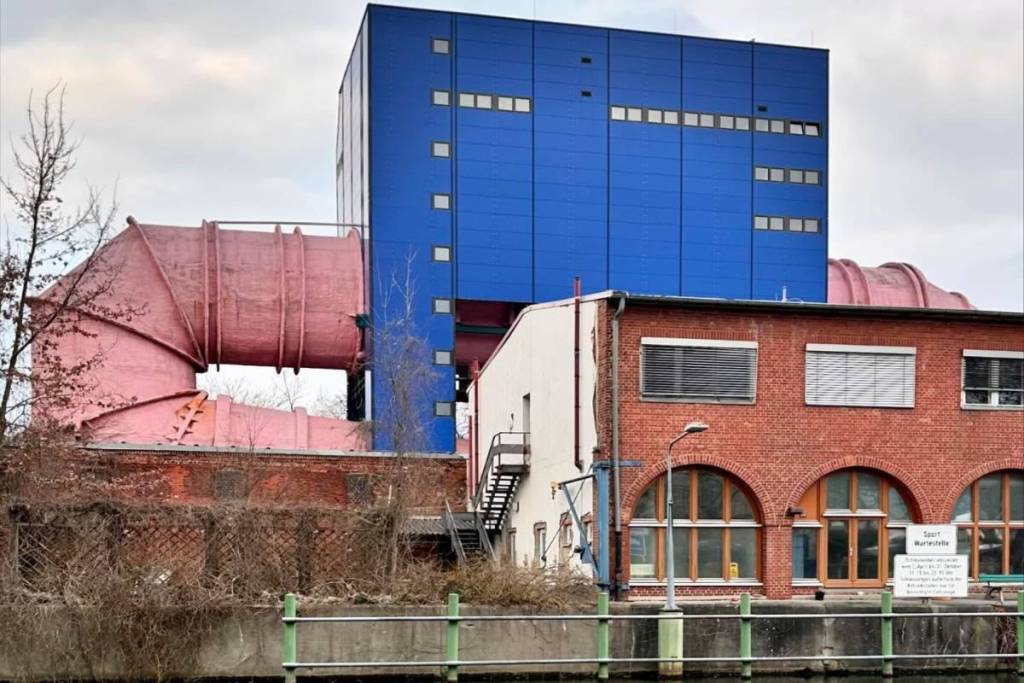
The address is Müller-Breslau-Straße 12, 10623 Berlin. The building is part of the former Research Institute for Hydraulic Engineering and Naval Architecture and is still used today for scientific research. From the outside, however, the building doesn’t look anything like a typical research facility. A huge pink tube winds around and through an angular, blue-clad structure. That’s why the recirculation tank is also known as the “Pink Tube” and is considered an icon of Berlin’s Pop Art architecture.
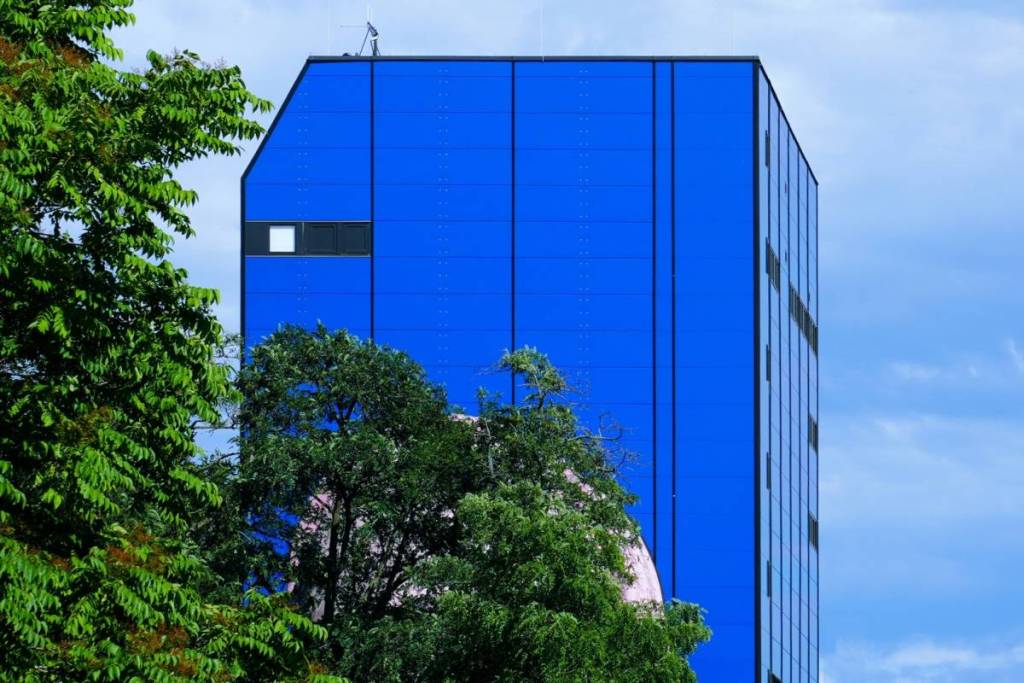
That’s exactly what makes this story so interesting: The spectacular tube isn’t a work of art or merely a facade design—it’s part of the actual research apparatus. The pink tube forms a closed-loop water circuit. A turbine sets the water inside in motion and can generate flow velocities of up to 10 meters per second. Inside the blue laboratory building is the measurement section where the flow is studied.
The building thus makes its technical function truly visible. That was also part of the architectural concept: the machine was not meant to disappear behind an ordinary building envelope, but to become the building itself. The Berlin Center for Industrial Culture describes the recirculation tank accordingly as an interface between architecture, industrial construction, machinery, and scientific equipment.
The TU Berlin uses the facility for flow and cavitation experiments. Here, ship models can be exposed to a controlled water flow to investigate , for example, nautical and marine engineering issues . According to the Berlin Center for Industrial Culture, models up to nine meters in length can be tested.
So this isn’t just a museum that serves as a reminder of its scientific past. The facility is still used for research. Even international experts come to Berlin to use the recirculation tank for their studies. The color wasn’t chosen at random. The building was designed by architect Ludwig Leo and completed—or rather, put into operation—in 1974. Together with hydraulic engineer Christian Boes, Leo developed an unusual architectural design in which the building’s technical function is immediately apparent.
The pink tube and the blue structure create an extremely striking contrast. The colors even help distinguish the building’s different functions: the pink tube is the water circulation system, while the blue structure houses the laboratory and measurement areas.