
If you’re looking for a quiet place to unwind in Berlin, you don’t have to head out to idyllic hiking trails outside the city. Amid the hustle and bustle of the big city and the gray building facades, you’ll find a surprising number of green oases where you can find a moment of peace. One of these is the Oriental-Islamic Garden, also known as the “Garden of the Four Streams.” It is located in the Gardens of the World in Berlin-Marzahn and was opened on July 7, 2005 . The garden was designed by landscape architect Kamel Louafi, who was advised by Moroccan garden historian Prof. Mohammed El Faïz.
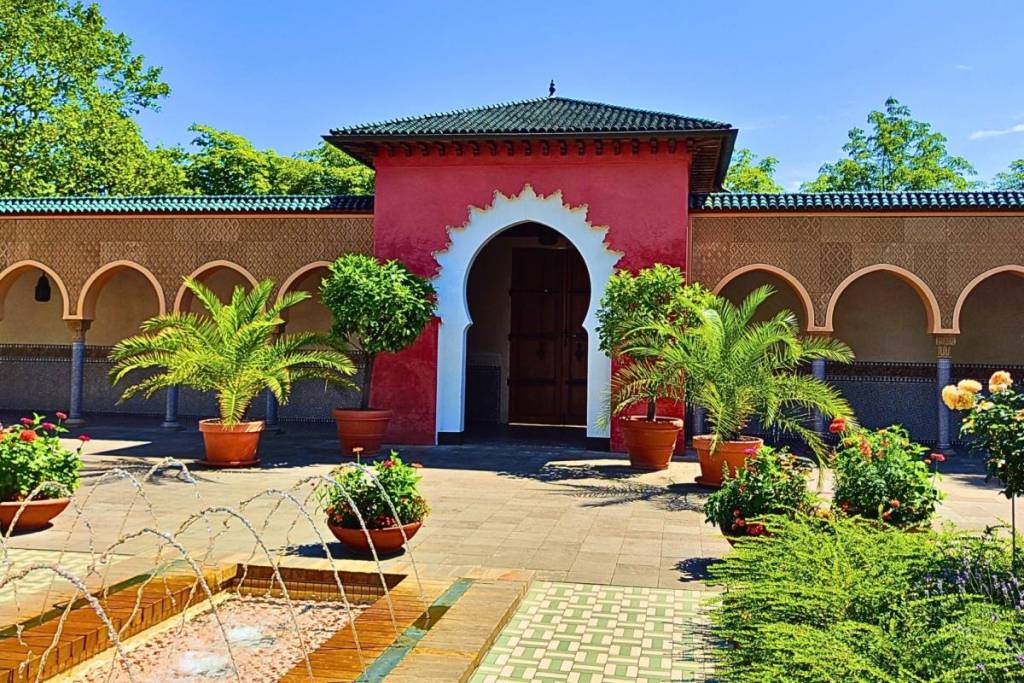
The actual walled garden courtyard measures approximately 63 × 38 meters. The complex was designed as an oriental garden courtyard, known as a riyad. A wall about four meters high encloses the garden, thus reflecting the traditional concept of a protected oasis. At the same time, the design draws on the historical idea of the garden as a “paradise on earth.” According to Gardens of the World, the term “paradise” is also associated with the Old Persian word pairidaeza, meaning a walled enclosure.
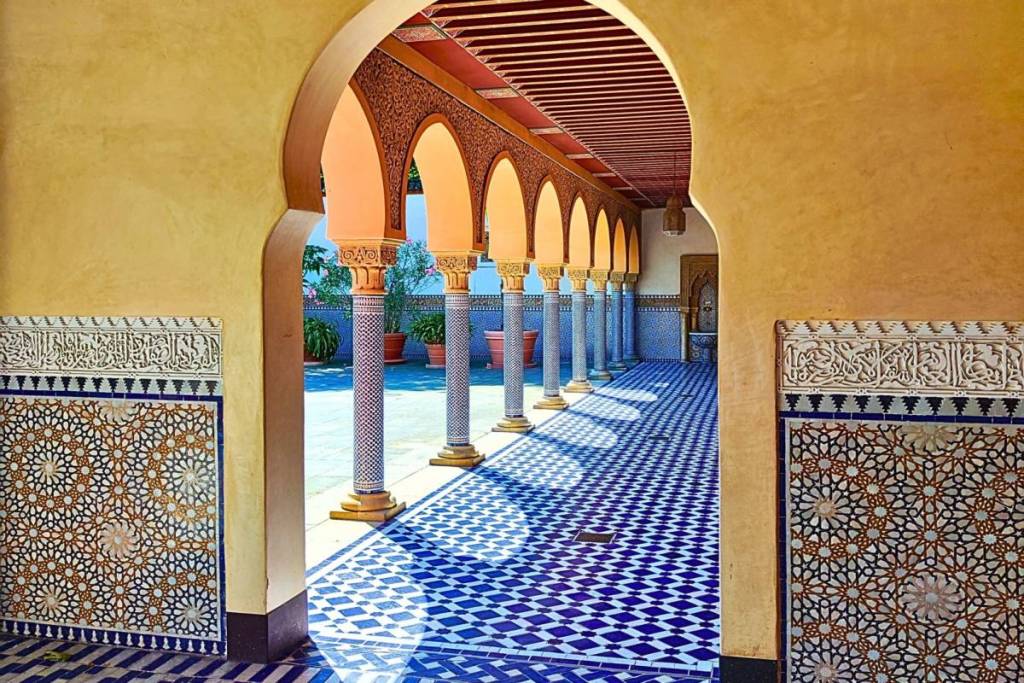
Particularly impressive is the Reception Hall, through which visitors enter the garden. The building was added in 2007 and is inspired by the architecture of the Alhambra in Granada. Among other things, the Sala de la Barca served as a specific model. The surrounding faience mosaic is also based on this historical model.
Inside , a glass dome, ornately decorated columns and arches, carved capitals, and Moroccan zellij tiles come together. Arcades, cedar wood elements, and elaborately decorated walls and floors also characterize the hall. So if you’re looking for a place in Berlin with a touch of the Alhambra, you’ll indeed find a fitting setting here. It’s important to note, however, that not the entire garden is modeled after the Alhambra. The Alhambra’s influence is most evident in the design of the reception hall, while the entire complex draws on Oriental-Islamic garden design.
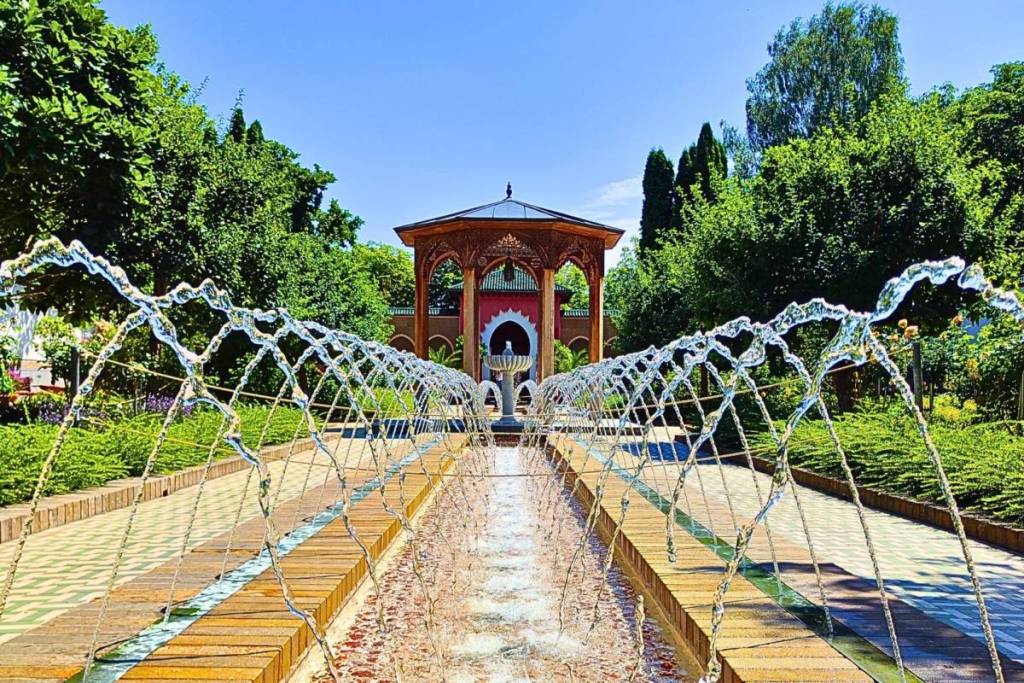
The garden has a strictly geometric layout. In its center is a large fountain basin, from which four waterways or pools extend into the four sections of the garden. Four rectangular flower beds are situated between the waterways.
This so-called “four-part layout” is typical of Oriental-Islamic garden design. Water not only serves a decorative function but is also symbolically linked to the concept of the Garden of Paradise. In addition to ornamental plants, the garden also features useful plants, allowing the space to combine beauty with practicality. The plantings further emphasize the garden’s Oriental character. Among other things , pomegranate and olive trees, palm trees, jasmine, oleander, lilac, geraniums, magnolias, and Judas treesgrow here. Various ornamental shrubs and perennials are also present.
Particularly striking is the Judas tree, whose violet-pink flowers sometimes appear directly on the wood in the spring, before the leaves develop. Another highlight is the numerous Moroccan zellij mosaics. According to Gardens of the World, approximately 1.3 million traditional mosaic tiles were used in the garden’s construction. The handcrafted elements can be found on walls, arcades, and floors, as well as on sandstone, plaster, and wooden features.