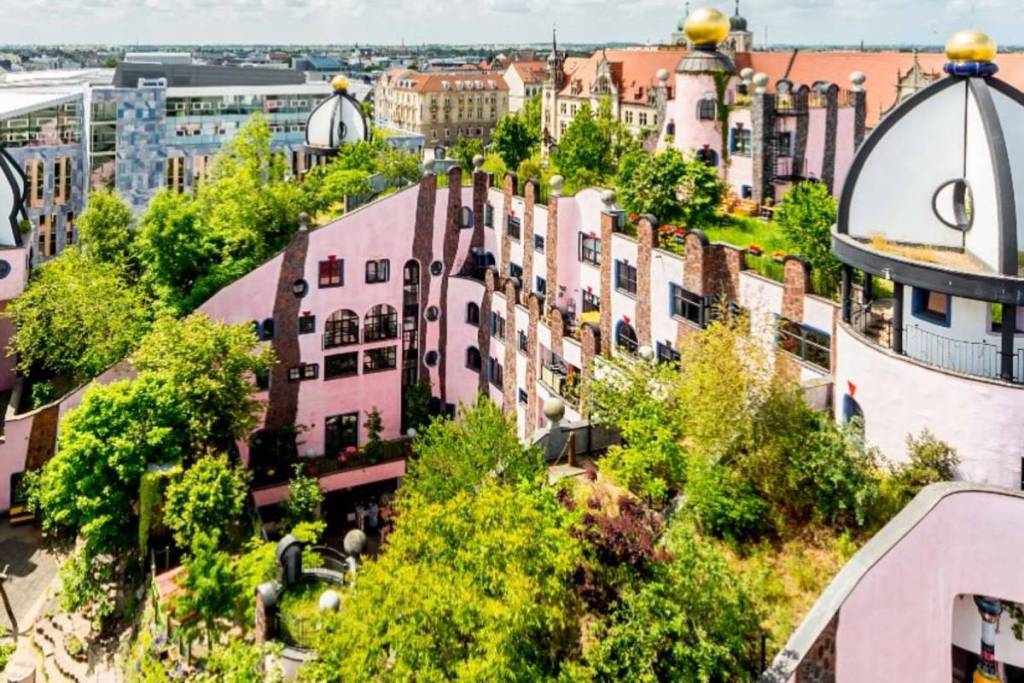

Unusual architecture is nothing out of the ordinary in Berlin. From the “Whale at the Brandenburg Gate,” designed by Frank O. Gehry, to one of the city’s most beautiful neo-Baroque halls at the Berlin Regional Court —there are plenty of unique structures to discover here. Yet some of Germany’s most fascinating architectural treasures are also located outside the capital—and, fortunately, not very far away. Right in the heart of Magdeburg stands a building that could hardly stand out more against the backdrop of the surrounding historic and modern architecture: The Green Citadel, with its pink facade, golden spheres, green roofs, and irregular windows, is one of Friedensreich Hundertwasser’s last major architectural projects.
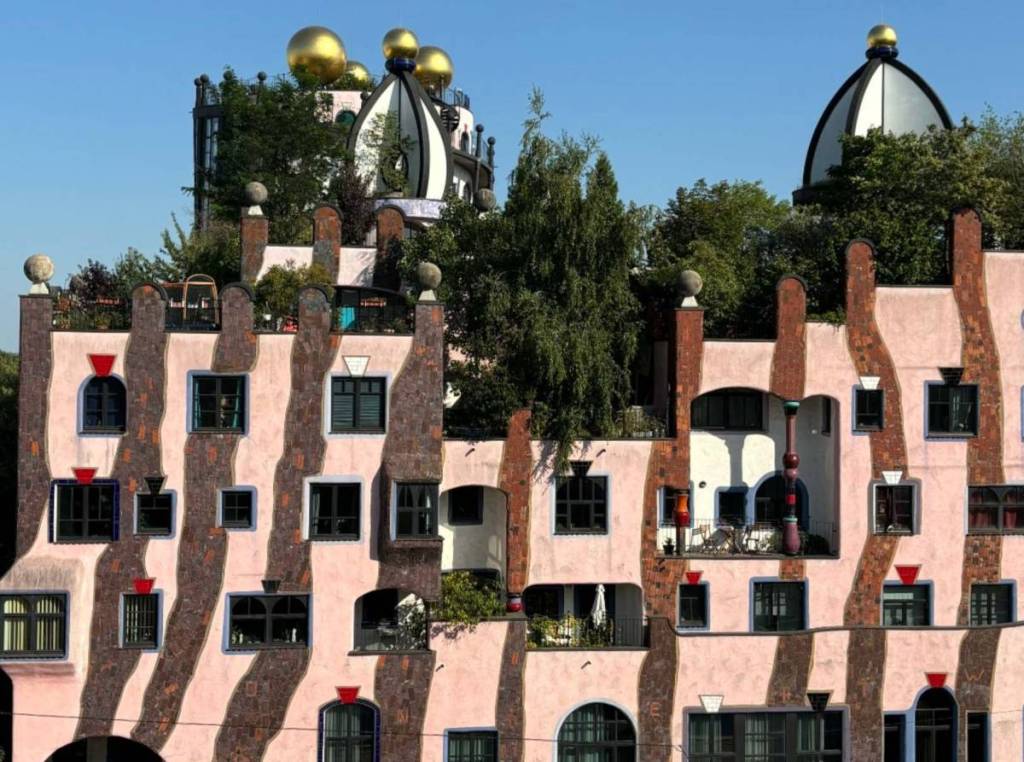
Its history began as early as the 1990s. Originally, Hundertwasser was supposed to simply redesign an existing prefabricated building on Breiten Weg. In 1998, he accepted the project, but the planned redesign eventually evolved into the idea of a completely new building. The existing structure was demolished, and Hundertwasser, together with architect Peter Pelikan, developed the plans for the new building.
By 1999, Hundertwasser’s plans were largely complete. Writing from New Zealand at the time, he stated that the Magdeburg project would become his “most beautiful and best building.” Hundertwasser himself also chose the name “The Green Citadel of Magdeburg.” However, he never got to see the finished building. Hundertwasser died on February 19, 2000, several years before construction actually began. By that time, however, his plans were already so far advanced that models, drawings, and detailed design specifications were available. Architects Peter Pelikan and Heinz M. Springmann were therefore able to bring the project to fruition after his death. Ground was broken in December 2003, and the cornerstone was laid in March 2004 . On October 3, 2005, the Green Citadel was finally officially inaugurated.
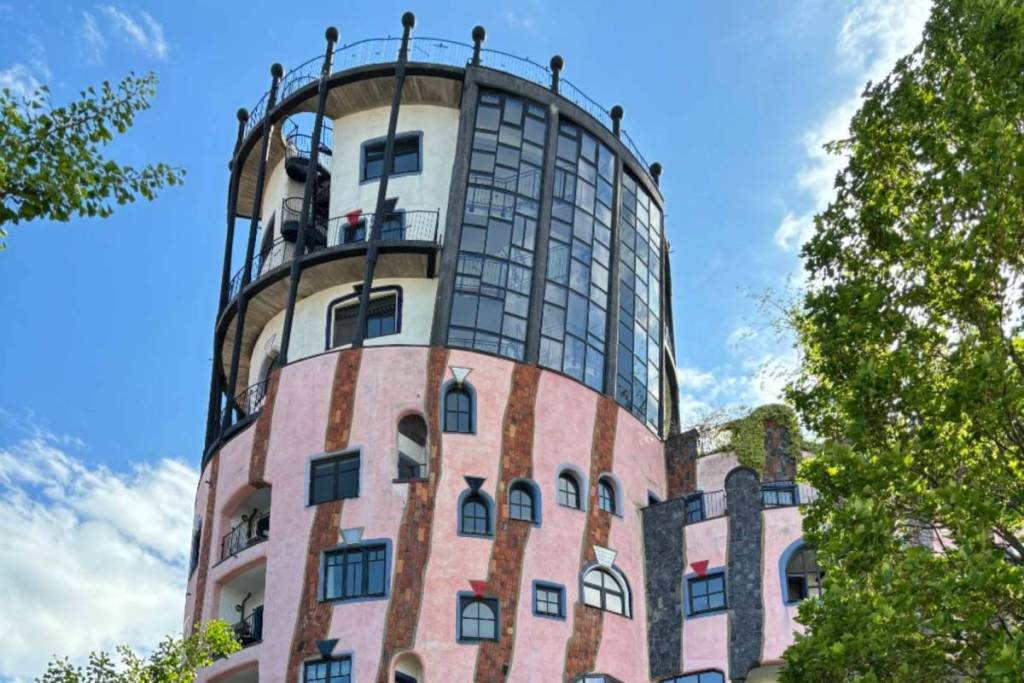
Anyone seeing the Green Citadel for the first time is likely to ask one question above all others: Why does a strikingly pink building bear the word “green” in its name? The “green” does not refer to the color of the facade, but to nature, which Hundertwasser sought to integrate into his architecture. There are green spaces, plants, and trees both on and around the building. The idea behind this is to give back to nature, at least in part, the space on the rooftops that was taken away from it by development at ground level.
The word “citadel” was also chosen deliberately. The name references Magdeburg’s past as an important fortified city. This is how the initiallycontradictory-sounding name “Green Citadel” came to be used for the pink building.