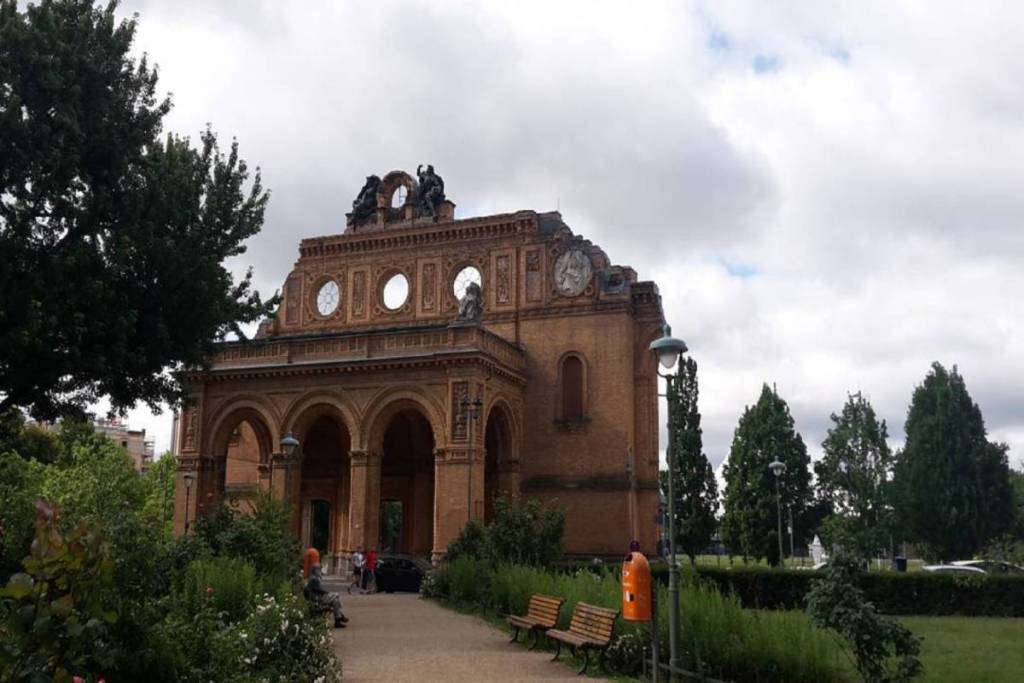

Buildings that are now merely a shadow of what they once were—there are plenty of them in Berlin, and many have fascinating stories behind them. For example, only fragments remain today of what was once the largest department store in the Weimar Republic. The situation is similar with the largest train station in continental Europe: all that remains of the once-monumental structure today is the entrance .
The first Anhalter Bahnhof was opened at this site as early as 1841. However, Berlin grew rapidly and rail traffic continued to increase, so that the original station soon became inadequate. Consequently, a much larger new building was constructed between 1876 and 1880 according to the plans of architect Franz Schwechten. On June 5, 1880, the new Anhalter Bahnhof was finally opened to traffic. The new building was enormous for its time. The station concourse was approximately 170 meters long and 62 meters wide and was framed by a monumental facade facing Askanischer Platz. At the time, Anhalter Bahnhof was considered the largest station on the European continent and was also Berlin’s terminus station with the highest train frequency.
Its significance, however, extended far beyond mere rail traffic. Anhalter Bahnhof developed into one ofBerlin’s most important transportation hubs and gateways . Due to its proximity to what was then the government district, it also served as the main and government station. At the same time, its construction had a decisive influence on the development of the surrounding neighborhoods west of Friedrichstadt. During the Nazi era, the station took on a grim significance. In the 1930s, it initially served as a departure point for people who were forced to leave Germany. Beginning in 1942, people were also deported from Anhalter Bahnhof.
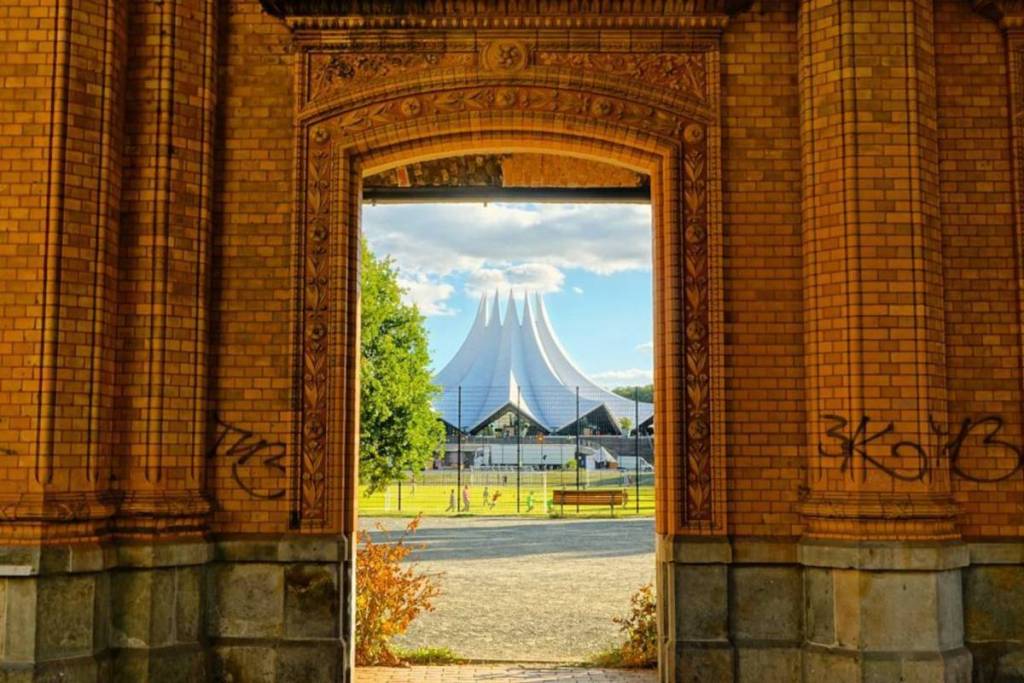
During World War II, the station was severely damaged. In February 1945, the monumental station building was largely destroyed by fire, and the roof over the platforms was also destroyed. Nevertheless, this did not spell the immediate end of Anhalter Bahnhof. After the war, it continued to be used, and regular train service operated there until 1952.
However, due to the war and the subsequent division of Berlin, the station gradually lost its importance. The once-thriving surrounding area had changed drastically, and the former transportation hub now lay off the main traffic routes. In 1960, the decision was finally made to demolish and remove the remaining parts of the monumental station. Exactly 80 years after the new building opened, this marked the beginning of the final disappearance of one of Berlin’s once most important stations. The demolition continued, in some cases, until 1961.
However, there were protests against its complete demolition. As a result, part of the historic structure was preserved: the striking ruins of the portal at Askanischer Platz. Today, it is a protected historic monument and still serves as a reminder of the immense size the Anhalter Bahnhof once had. Other traces of the original station complex have also survived. Parts of the former railway depot are now part of the German Museum of Technology. Historic locomotive sheds have been integrated into the museum, thereby preserving another part of the site’s railway history.