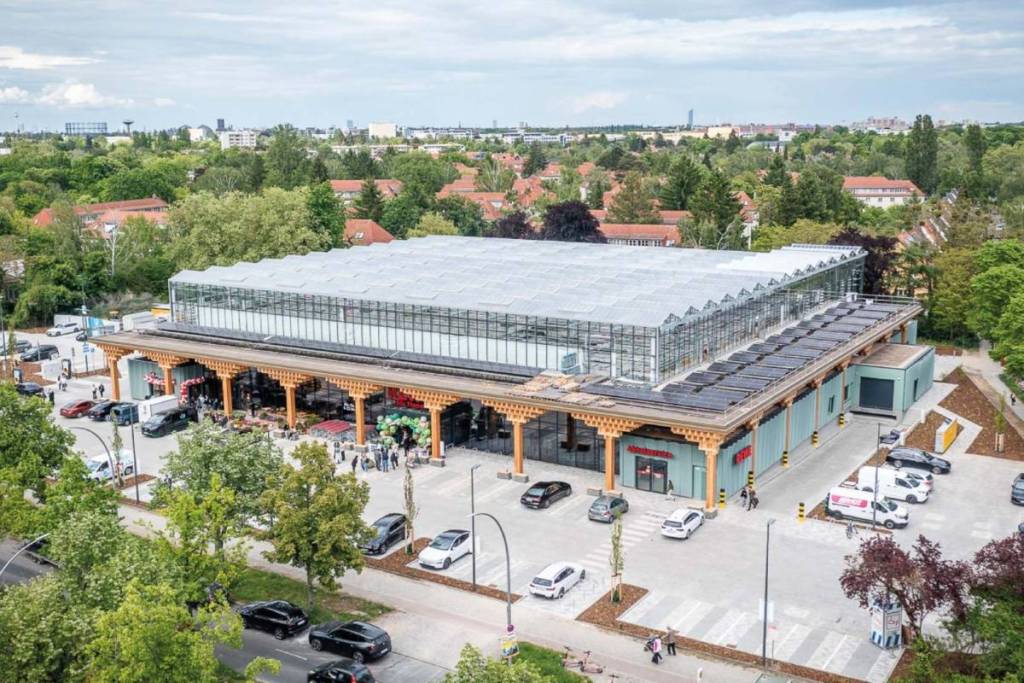

Berlin’s restaurant scene could hardly be more colorful and exciting. From the recently set world record for a vegan potluck brunch to Germany’s first all-plant-based REWE market, the capital continues to demonstrate just how diverse the future of food can be. But REWE has yet another extraordinary concept to offer in Berlin: The REWE Green Farming Market is located on Malteserstraße in Lankwitz, in the Steglitz-Zehlendorf district. What makes it special is the direct link between sales and food production— because while shoppers browse downstairs, some of the food that will later be sold in the store is growing right on the roof.
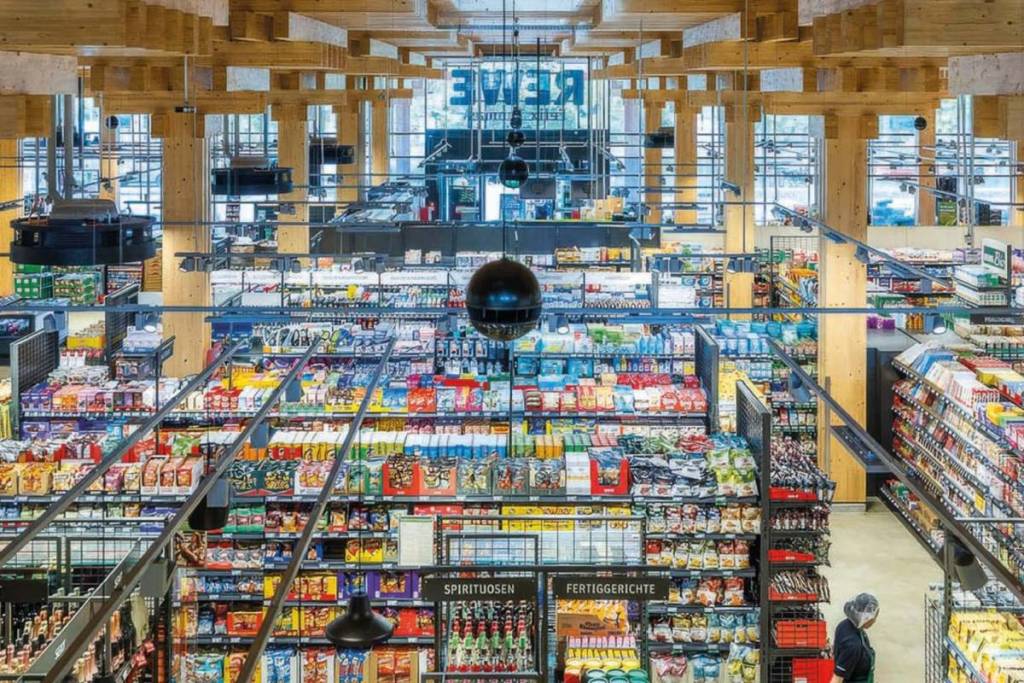
While shoppers buy groceries downstairs in the approximately 2,150-square-meter market hall, new produce is already growing just one floor above. The building features a glass-enclosed rooftop farm covering an area of about 2,760 square meters. In the future, up to 900,000 salad mixes per year could be produced there. The facility has actually been in operation since August 2026. On August 7, the first “Lankwitz Pick-Your-Own Lettuce” was harvested on the roof. Unlike at REWE’s first Green Farming market in Wiesbaden, neither fish nor basil are raised or grown on the Berlin rooftop. Instead, the Berlin facility focuses on pick-your-own lettuce. The “Lankwitz Pick-Your-Own Lettuce” consists of four different varieties: iceberg lettuce, romaine lettuce, Lollo Rosso, and dark green Easy Leaf.
What’s particularly remarkable is how quickly the plants grow. The lettuce is grown on special trays that are automatically moved through the greenhouse as the plants grow. Several times a day, the plants are supplied with a precisely formulated nutrient solution. They’re ready for harvest after just about 23 days. The lettuces are then transported via a conveyor belt for processing. They are processed and packaged on-site before being sold in the supermarket below or shipped to other REWE stores. It takes just over three weeks from seedling to harvest-ready plant.
This intensive production is made possible by a hydroponic growing system. The lettuces do not grow in soil like they would in a conventional field, but are instead supplied with a controlled nutrient solution. This allows cultivation to be managed largely independently of the conditions found on traditional farmland. Some of the water needed is also sourced directly from the building. Rainwater from the roof is collected and stored in a cistern before being used for the plants. The largely automated system enables continuous production. At the same time, the waste heat from the supermarket below is utilized. Heat pumps and the reuse of the generated heat help create the necessary conditions in the market and in the greenhouse.
The lettuce produced on the roof isn’t intended exclusively for the store in Lankwitz. The Berlin rooftop farm is expected to supply around 500 REWE stores in the region and in eastern Germany with its harvest. However, this does not mean that 500 REWE supermarkets now have their own rooftop farms. Rather, it is a central rooftop farm in Berlin, whose produce is then distributed to hundreds of other stores via existing logistics networks .
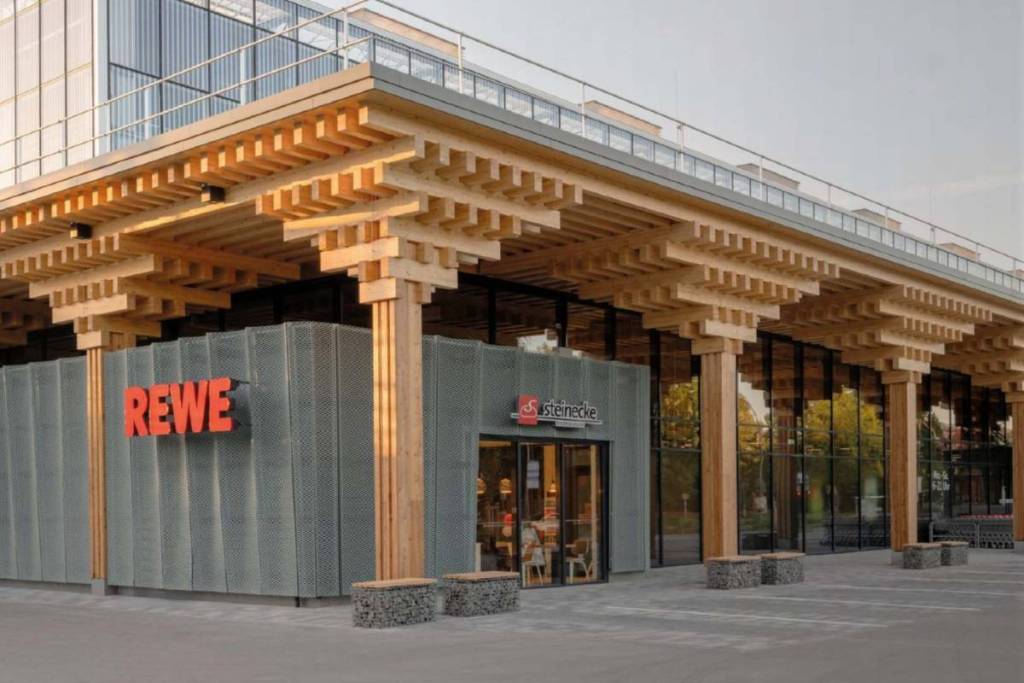
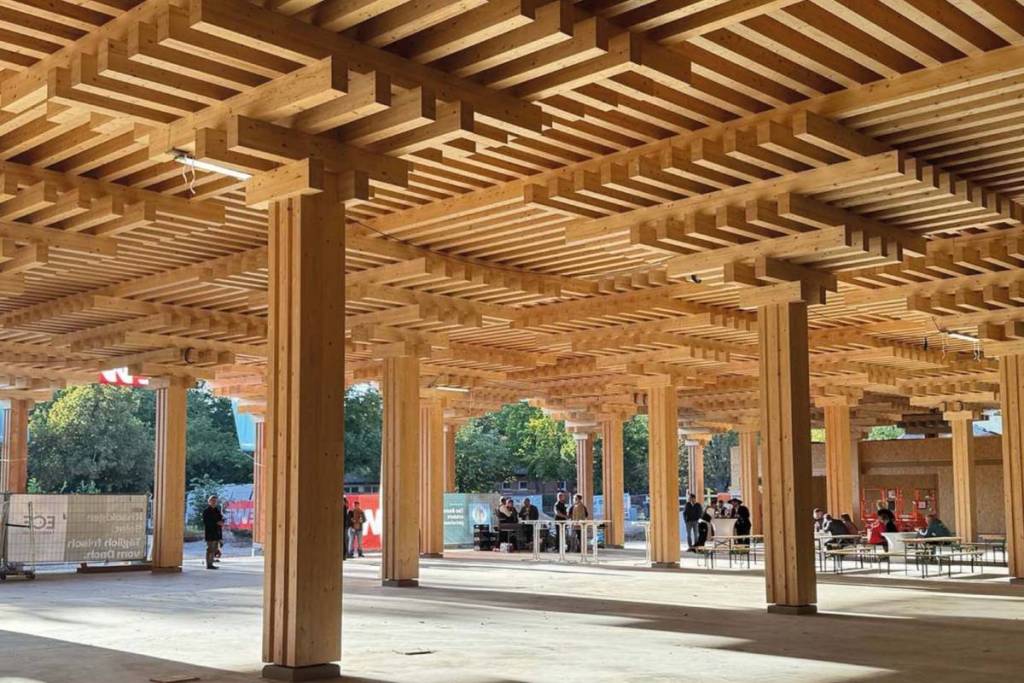
It’s not just the rooftop farming that sets this market apart from an ordinary supermarket. The building was designed as a large wood-and-glass market hall by the London-based architectural firm ACME. The structure is supported by a total of 72 wooden columns. Particularly striking are the capitals, which consist of layered wooden elements and create an unusual vaulted structure beneath the ceiling. As a result, the interior is more reminiscent of a modern market hall than a traditional supermarket.
In addition to the rooftop farm and the wooden structure, the market features other measures to reduce its resource and energy consumption. There are around 200 solar panels on the building. These are complemented by a supply of green electricity, heat pumps, the use of waste heat and rainwater, and permeable paving in the parking lots. According to REWE, the combination of these measures is intended to make the Green Farming Market
Berlin, however, is not the first location where REWE has combined agriculture and a supermarket. The company’s first Green Farming Market opened in Wiesbaden-Erbenheim back in 2021. A different concept was implemented there: basil and cichlids were produced on the roof in an aquaponics system. The facility was designed to produce approximately 800,000 basil plants and 20,000 fish per year .
The Berlin store represents a further development of this concept. Here, the rooftop farm focuses entirely on lettuce and uses hydroponics. At the same time, the building design has been refined in areas such as timber construction, heat supply, and digital planning. According to REWE, the Lankwitz location is also the company’s first store to be planned entirely using Building Information Modeling, or BIM for short. This involves creating a detailed digital model of the building, which allows for precise planning of the structure and technical systems both before and during construction.